Back

Introduction to Protein-Ligand Interactions definitions

Control buttons has been changed to "navigation" mode.
1/14
  • Ligand

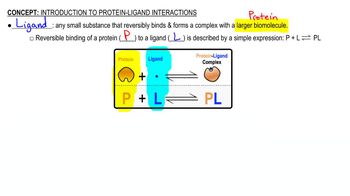
    A small substance capable of binding to a larger biomolecule, often forming a reversible complex with a protein.
  • Protein

    A large biomolecule that interacts with smaller substances, serving as the primary binding partner in reversible complexes.
  • Protein-Ligand Complex

    A reversible association formed when a protein and a ligand bind, denoted as PL in biochemical notation.
  • Reversible Binding

    A process where two molecules associate and dissociate repeatedly, maintaining equilibrium between free and bound states.
  • Association Rate Constant

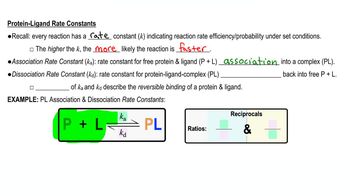
    A parameter, abbreviated as k_a, quantifying the efficiency and speed of complex formation between protein and ligand.
  • Dissociation Rate Constant

    A parameter, abbreviated as k_d, measuring how quickly a protein-ligand complex separates into its individual components.
  • Rate Constant

    A value, symbolized by k, representing the probability and efficiency of a reaction under specific conditions.
  • Equilibrium Arrows

    Symbols indicating that a reaction can proceed in both directions, signifying reversibility in biochemical processes.
  • Enzyme-Substrate Interaction

    A reversible association where an enzyme binds a substrate, often leading to conversion into a product.
  • Reciprocal Ratio

    A mathematical relationship where the ratio of k_d to k_a provides insight into the dynamics of reversible binding.
  • Biomolecule

    A large, biologically relevant molecule, such as a protein, that can interact with smaller substances like ligands.
  • Product

    A substance resulting from enzymatic conversion of a substrate, distinct from the outcome of protein-ligand binding.
  • Substrate

    A molecule that binds to an enzyme and is transformed into a product during enzymatic reactions.
  • Notation

    A system of symbols, such as P for protein and L for ligand, used to represent molecular entities in biochemistry.