Skip to main content
Biochemistry
My Course
Learn
Exam Prep
AI Tutor
Study Guides
Flashcards
Explore
Try the app
My Course
Learn
Exam Prep
AI Tutor
Study Guides
Flashcards
Explore
Try the app
Back
Isoelectric Point definitions
You can tap to flip the card.
Isoelectric Point
You can tap to flip the card.
👆
Isoelectric Point
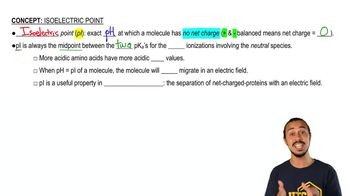
Specific pH where a molecule's positive and negative charges are balanced, resulting in zero net charge.
Track progress
Control buttons has been changed to "navigation" mode.
1/13
Related flashcards
Related practice
Recommended videos
Isoelectric Point quiz #1
Isoelectric Point
10 Terms
Isoelectric Point
3. Amino Acids
7 problems
Topic
Isoelectric Point of Amino Acids with Ionizable R-Groups
3. Amino Acids
4 problems
Topic
3. Amino Acids - Part 1 of 3
5 topics
15 problems
Chapter
3. Amino Acids - Part 2 of 3
5 topics
14 problems
Chapter
3. Amino Acids - Part 3 of 3
7 topics
16 problems
Chapter
Guided course
02:32
Isoelectric Point of Amino Acids
1980
views
17
rank
Guided course
04:00
Isoelectric Point of Amino Acids
2332
views
27
rank
Terms in this set (13)
Hide definitions
Isoelectric Point
Specific pH where a molecule's positive and negative charges are balanced, resulting in zero net charge.
pI
Abbreviation for the pH at which a molecule exhibits no net charge, crucial for protein separation techniques.
Amino Acid
Building block of proteins, each with unique side chains and characteristic pKa values affecting charge at different pH.
pKa
Value indicating the pH at which a specific group on a molecule loses or gains a proton, used in pI calculations.
R Group
Side chain of an amino acid, determining its properties; can be ionizable or non-ionizable, affecting pI calculation.
Non-Ionizable R Group
Side chain that does not participate in ionization, simplifying pI calculation to averaging two pKa values.
Acidic Amino Acid
Type of amino acid with lower pI values due to more acidic side chains, influencing net charge at various pH.
Basic Amino Acid
Type of amino acid with higher pI values, attributed to basic side chains, affecting charge at different pH levels.
Electrophoresis
Technique using electric fields to separate molecules based on net charge, with migration halted at pI.
Net Charge
Sum of positive and negative charges on a molecule, reaching zero at the isoelectric point.
Neutral Species
Form of a molecule where positive and negative charges are balanced, used in pI calculation.
Valine
Amino acid with a non-ionizable R group, requiring only two pKa values for pI determination.
Protein
Macromolecule composed of amino acids, whose net charge and pI are key for separation and identification.
 BackBack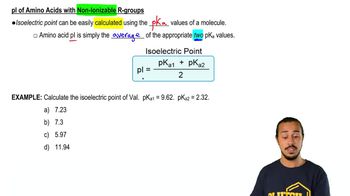
 02:32
02:32