Back

Isoprenoids quiz

Control buttons has been changed to "navigation" mode.
1/15
  • What is the basic building block molecule of isoprenoids?

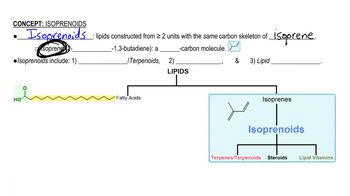
    The basic building block of isoprenoids is isoprene, a 5-carbon molecule known as 2-methyl-1,3-butadiene.
  • How are isoprenoids different from fatty acid-based lipids?

    Isoprenoids are constructed from isoprene units, while fatty acid-based lipids are built from fatty acids.
  • What are the three major classes of isoprenoids?

    The three major classes of isoprenoids are terpenes and terpenoids, steroids, and lipid vitamins.
  • What is the IUPAC name for isoprene?

    The IUPAC name for isoprene is 2-methyl-1,3-butadiene.
  • How many carbons are in an isoprene molecule?

    An isoprene molecule contains 5 carbon atoms.
  • What structural feature distinguishes terpenes from terpenoids?

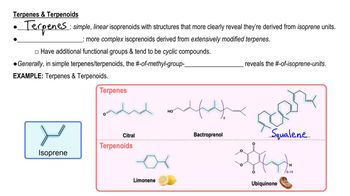
    Terpenes are simple, linear isoprenoids, while terpenoids are more complex, often cyclic, and have additional functional groups.
  • What is the best indicator for the number of isoprene units in a molecule?

    The number of methyl group branch points is the best indicator of the number of isoprene units in a molecule.
  • Why is counting double bonds not a reliable way to determine the number of isoprene units?

    Counting double bonds is not reliable because the number of double bonds does not always correspond to the number of isoprene units.
  • What is squalene and to which class of isoprenoids does it belong?

    Squalene is a key terpene, which is a simple, linear isoprenoid.
  • What is a common source of the terpenoid limonene?

    Limonene is commonly found in lemons and lemonade.
  • What is the main chain length and double bond position in isoprene?

    Isoprene has a four-carbon main chain with double bonds at positions 1 and 3.
  • What is the significance of methyl group branch points in isoprenoids?

    Methyl group branch points indicate where methyl groups branch off, helping to reveal the number of isoprene units in the molecule.
  • What is ubiquinone and to which class of isoprenoids does it belong?

    Ubiquinone is a terpenoid found in mitochondria, and it has a cyclic structure with additional functional groups.
  • How are terpenoids typically formed from terpenes?

    Terpenoids are typically formed by extensively modifying terpenes, adding functional groups and often creating cyclic structures.
  • Why is understanding isoprenoid structure important in biochemistry?

    Understanding isoprenoid structure is essential for studying lipid diversity, membrane-associated electron transport, and biochemical pathways involving lipids and vitamins.