Back

Mass Spectrum quiz

Control buttons has been changed to "navigation" mode.
1/15
  • What does a mass spectrum plot on its axes?

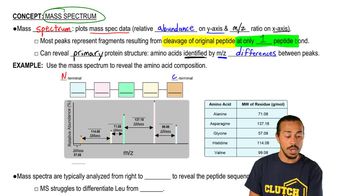
    A mass spectrum plots relative abundance on the y-axis and mass-to-charge (m/z) ratio on the x-axis.
  • How are peptide fragments typically generated in mass spectrometry?

    Peptide fragments are typically generated by cleavage at a single peptide bond during ionization.
  • What information about a protein can be revealed by analyzing a mass spectrum?

    A mass spectrum can reveal the primary structure of a protein, including its amino acid sequence.
  • How are individual amino acids identified in a mass spectrum?

    Individual amino acids are identified by calculating the mass difference between adjacent peaks, which corresponds to the mass of the cleaved residue.
  • Why are most amino acids uniquely identifiable by mass spectrometry?

    Most amino acids have unique molecular weights, allowing them to be distinguished by their mass differences in the spectrum.
  • Which two amino acids cannot be distinguished by mass spectrometry and why?

    Leucine and isoleucine cannot be distinguished because they are isomers with identical molecular weights.
  • In which direction is a mass spectrum typically analyzed to determine the peptide sequence?

    A mass spectrum is typically analyzed from right to left to determine the peptide sequence from N-terminal to C-terminal.
  • What are b ions and what do they contain?

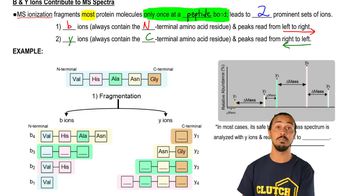
    B ions are peptide fragments that always contain the N-terminal amino acid residue.
  • What are y ions and what do they contain?

    Y ions are peptide fragments that always contain the C-terminal amino acid residue.
  • From which direction are b ions read in a mass spectrum?

    B ions are read from left to right in a mass spectrum.
  • From which direction are y ions read in a mass spectrum?

    Y ions are read from right to left in a mass spectrum.
  • Why are y ions more prominent in a mass spectrum than b ions?

    Y ions are more stable and abundant, making them the most prominent peaks in the spectrum.
  • What does the largest m/z peak on the right of a mass spectrum typically represent?

    The largest m/z peak on the right typically represents the unfragmented peptide.
  • How does fragmentation at a single peptide bond affect the mass spectrum?

    Fragmentation at a single peptide bond produces two ions, a b ion and a y ion, each corresponding to different ends of the peptide.
  • Why do we focus on y ions when analyzing mass spectra for protein sequencing?

    We focus on y ions because they are more stable, more abundant, and provide a clear sequence from the C-terminal end.