Back

Membrane Transport 1 definitions

Control buttons has been changed to "navigation" mode.
1/15
  • Simple Diffusion

    Movement of nonpolar or small polar molecules across membranes without energy input, relying solely on concentration gradients.
  • Facilitated Diffusion

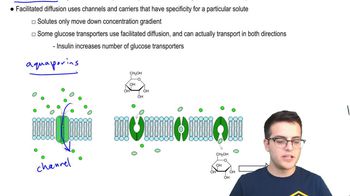
    Transport of solutes across membranes via specific channels or carriers, allowing movement down electrochemical gradients.
  • Aquaporin

    Protein channel specialized for rapid water transport across cell membranes, enhancing water movement beyond simple diffusion.
  • Channel

    Membrane protein forming an open passage for solutes, often selective and sometimes gated, enabling directional movement.
  • Carrier

    Membrane protein that binds and shuttles solutes across membranes, typically moving them down concentration gradients.
  • Glucose Transporter

    Carrier protein facilitating glucose movement across membranes, often aided by intracellular conversion to maintain gradient.
  • Glucose 6 Phosphate

    Intracellular molecule formed from glucose, helping maintain low internal glucose concentration and driving import.
  • Passive Transport

    Membrane transport processes that occur without energy input, including simple and facilitated diffusion.
  • Active Transport

    Energy-dependent movement of solutes against concentration gradients, often via specialized membrane pumps.
  • Primary Active Transport

    Direct use of ATP to drive solute movement against gradients, typically through membrane pumps.
  • Pump

    Membrane protein utilizing energy to move ions or molecules against their electrochemical gradients.
  • Na+/K+ ATPase

    Pump exchanging sodium and potassium ions across membranes, maintaining cellular electrochemical balance using ATP.
  • Proton Pump

    Membrane protein moving hydrogen ions to generate a gradient essential for ATP synthesis in mitochondria.
  • Protonmotive Force

    Electrochemical gradient of protons across membranes, driving ATP production via ATP synthase.
  • ATP Synthase

    Enzyme utilizing proton gradients to convert ADP and inorganic phosphate into ATP during cellular respiration.