Back

Membrane Transport 2 definitions

Control buttons has been changed to "navigation" mode.
1/12
  • Primary Active Transport

    Directly utilizes energy to move substances across membranes, establishing gradients essential for cellular function.
  • Secondary Active Transport

    Harnesses the electrochemical gradient of one substance to drive another substance against its own gradient.
  • Electrochemical Gradient

    Combination of concentration and electrical differences across a membrane, providing potential energy for transport.
  • Proton Pump

    Membrane protein that moves protons to create a gradient, resulting in high and low concentrations on opposite sides.
  • Chemical Gradient

    Difference in solute concentration across a membrane, forming a basis for energy storage and transport.
  • ATP Synthase

    Enzyme that utilizes the energy from protons moving down their gradient to synthesize ATP in cells.
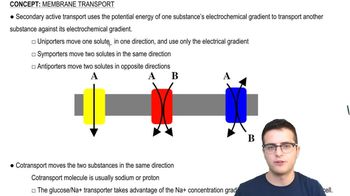
  • Uniporter

    Transport protein moving a single solute in one direction, often using an electrical gradient for movement.
  • Symporter

    Transporter moving two solutes simultaneously in the same direction, with one moving against and one down its gradient.
  • Antiporter

    Transporter moving two solutes in opposite directions, with one moving against and one down its gradient.
  • Cotransport

    Mechanism involving simultaneous movement of multiple solutes, typically via symporters or antiporters.
  • Concentration Gradient

    Difference in solute concentration across a membrane, driving passive and active transport processes.
  • Electrical Gradient

    Difference in charge across a membrane, contributing to the movement of ions and other charged molecules.