Back

Membrane Transport 2 quiz

Control buttons has been changed to "navigation" mode.
1/15
  • What is the main difference between primary and secondary active transport?

    Primary active transport directly uses energy to move substances, while secondary active transport uses the electrochemical gradient of one substance to move another against its gradient.
  • How do proton pumps create a chemical gradient across a membrane?

    Proton pumps move protons across a membrane, resulting in a high concentration on one side and a low concentration on the other.
  • What can the energy released from protons moving down their concentration gradient be used for?

    It can be harnessed to transport other substances against their electrochemical gradients.
  • What are the three types of secondary active transport?

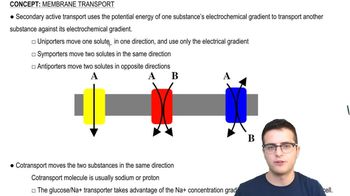
    The three types are uniporters, simporters (symporters), and antiporters.
  • How does a uniporter function in secondary active transport?

    A uniporter moves one solute in one direction using an electrical gradient created by primary active transport.
  • What is the role of a symporter in membrane transport?

    A symporter transports two solutes in the same direction, with one moving against its gradient and the other moving down its gradient.
  • How do antiporters operate in secondary active transport?

    Antiporters move two solutes in opposite directions, with one moving against its gradient and the other moving down its gradient.
  • What is cotransport in the context of membrane transport?

    Cotransport refers to the combined action of symporters and antiporters moving multiple solutes simultaneously.
  • What is exploited in secondary active transport to move substances against their gradient?

    The potential energy of one substance's electrochemical gradient is exploited to move another substance against its gradient.
  • In secondary active transport, what is the direction of movement for the solute moving against its gradient?

    The solute moves from low concentration to high concentration, against its electrochemical gradient.
  • What creates the electrical gradient used by uniporters?

    An electrical gradient is created by a pump using primary active transport.
  • In symporters, how does the second solute (B) move relative to its gradient?

    The second solute (B) moves down its electrochemical gradient.
  • In antiporters, how do the two solutes move relative to each other?

    The two solutes move in opposite directions, with one moving against its gradient and the other moving down its gradient.
  • What is the main function of proton pumps besides ATP synthesis?

    Proton pumps can also be used to transport other substances by creating a gradient that powers secondary active transport.
  • What is the relationship between primary active transport and secondary active transport?

    Primary active transport establishes gradients that secondary active transport uses to move other substances against their gradients.