Back

Myoglobin vs. Hemoglobin definitions

Control buttons has been changed to "navigation" mode.
1/15
  • Myoglobin

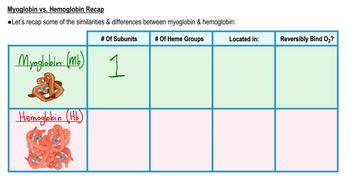
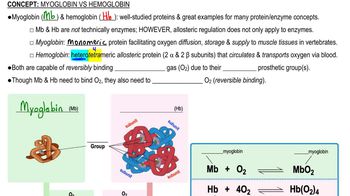
    Monomeric protein in muscle tissue, stores oxygen using a single heme group, and exhibits simple ligand binding.
  • Hemoglobin

    Heterotetrameric allosteric protein in red blood cells, transports oxygen with four heme groups and complex ligand binding.
  • Heme Group

    Disc-shaped prosthetic component enabling reversible oxygen binding in both myoglobin and hemoglobin.
  • Oxygen

    Ligand molecule reversibly bound by heme groups in myoglobin and hemoglobin for storage or transport.
  • Allosteric Regulation

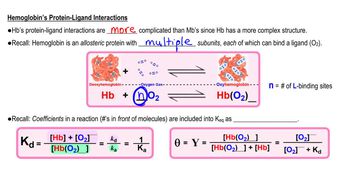
    Modulation of protein function through structural changes, prominent in hemoglobin due to multiple subunits.
  • Subunit

    Individual polypeptide chain forming part of a protein; myoglobin has one, hemoglobin has four.
  • Alpha Subunit

    Identical polypeptide chain type found twice in hemoglobin, contributing to its heterotetrameric structure.
  • Beta Subunit

    Identical polypeptide chain type found twice in hemoglobin, distinct from alpha subunits.
  • Red Blood Cell

    Cell type, also called erythrocyte, housing hemoglobin for oxygen transport in the bloodstream.
  • Erythrocyte

    Technical term for red blood cell, the site of hemoglobin molecules in blood.
  • Fractional Saturation

    Ratio indicating proportion of protein molecules bound to ligand, used to describe oxygen binding.
  • Dissociation Equilibrium Constant

    Quantitative measure of protein-ligand affinity, represented as Kd, lower values indicate tighter binding.
  • Oxymyoglobin

    Oxygenated form of myoglobin, resulting from binding a single oxygen molecule to its heme group.
  • Oxyhemoglobin

    Oxygenated form of hemoglobin, with four oxygen molecules bound to its four heme groups.
  • Protein-Ligand Interaction

    Binding relationship between a protein and a molecule, central to oxygen storage and transport in myoglobin and hemoglobin.