Skip to main content
Biochemistry
My Course
Learn
Exam Prep
AI Tutor
Study Guides
Flashcards
Explore
Try the app
My Course
Learn
Exam Prep
AI Tutor
Study Guides
Flashcards
Explore
Try the app
Back
Non-Ionizable Vs. Ionizable R-Groups definitions
You can tap to flip the card.
Amino Acid
You can tap to flip the card.
👆
Amino Acid
Building block of proteins, each with a unique R group that determines its chemical properties and behavior in biological systems.
Track progress
Control buttons has been changed to "navigation" mode.
1/15
Related flashcards
Related practice
Recommended videos
Non-Ionizable Vs. Ionizable R-Groups quiz
Non-Ionizable Vs. Ionizable R-Groups
15 Terms
Non-Ionizable Vs. Ionizable R-Groups
3. Amino Acids
7 problems
Topic
Isoelectric Point
3. Amino Acids
7 problems
Topic
3. Amino Acids - Part 1 of 3
5 topics
15 problems
Chapter
3. Amino Acids - Part 2 of 3
5 topics
14 problems
Chapter
3. Amino Acids - Part 3 of 3
7 topics
16 problems
Chapter
Guided course
02:31
Memorizing Amino Acids With Ionizable R-Groups
1989
views
14
rank
1
comments
Guided course
06:20
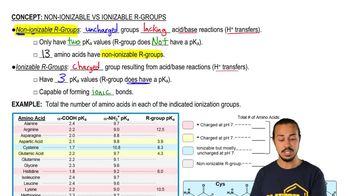
Non-Ionizable Vs. Ionizable R-Groups
4188
views
27
rank
2
comments
Terms in this set (15)
Hide definitions
Amino Acid
Building block of proteins, each with a unique R group that determines its chemical properties and behavior in biological systems.
R Group
Side chain attached to the central carbon of an amino acid, responsible for its distinct chemical characteristics.
Non-Ionizable R Group
Side chain that remains uncharged due to lack of acid-base reactions, resulting in only two pKa values for the amino acid.
Ionizable R Group
Side chain capable of gaining or losing charge through acid-base reactions, contributing a third pKa value to the amino acid.
pKa
Value indicating the pH at which a group can donate or accept a proton, crucial for understanding ionization states.
Ionic Bond
Electrostatic interaction formed between charged groups, important for protein structure and function.
Arginine
Amino acid with a positively charged ionizable R group at physiological pH, often involved in basic interactions.
Histidine
Amino acid with an ionizable R group that can be positively charged at physiological pH, playing a role in enzyme activity.
Lysine
Amino acid with a basic, positively charged ionizable R group at physiological pH, contributing to protein charge.
Aspartate
Amino acid with a negatively charged ionizable R group at physiological pH, classified as acidic.
Glutamate
Amino acid with a negatively charged ionizable R group at physiological pH, important for acidic interactions.
Cysteine
Amino acid with a sulfhydryl-containing ionizable R group, uncharged at pH 7 but gains negative charge above pH 8.3.
Tyrosine
Amino acid with a phenolic ionizable R group, uncharged at pH 7 but gains negative charge above pH 10.1.
Physiological pH
Typical pH of biological systems, around 7, used as a reference for amino acid charge states.
Acid-Base Reaction
Chemical process involving proton transfer, essential for ionization of certain amino acid side chains.
 BackBack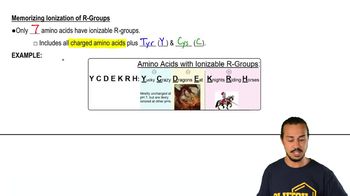
 02:31
02:31