Skip to main content
Biochemistry
My Course
Learn
Exam Prep
AI Tutor
Study Guides
Flashcards
Explore
Try the app
My Course
Learn
Exam Prep
AI Tutor
Study Guides
Flashcards
Explore
Try the app
Back
Non-Ionizable Vs. Ionizable R-Groups quiz
You can tap to flip the card.
What is the main difference between non-ionizable and ionizable R groups in amino acids?
You can tap to flip the card.
👆
What is the main difference between non-ionizable and ionizable R groups in amino acids?
Non-ionizable R groups cannot gain a charge and lack acid-base reactions, while ionizable R groups can gain a charge through acid-base reactions.
Track progress
Control buttons has been changed to "navigation" mode.
1/15
Related flashcards
Related practice
Recommended videos
Non-Ionizable Vs. Ionizable R-Groups definitions
Non-Ionizable Vs. Ionizable R-Groups
15 Terms
Non-Ionizable Vs. Ionizable R-Groups
3. Amino Acids
7 problems
Topic
Isoelectric Point
3. Amino Acids
7 problems
Topic
3. Amino Acids - Part 1 of 3
5 topics
15 problems
Chapter
3. Amino Acids - Part 2 of 3
5 topics
14 problems
Chapter
3. Amino Acids - Part 3 of 3
7 topics
16 problems
Chapter
Guided course
02:31
Memorizing Amino Acids With Ionizable R-Groups
1988
views
14
rank
1
comments
Guided course
06:20
Non-Ionizable Vs. Ionizable R-Groups
4186
views
27
rank
2
comments
Terms in this set (15)
Hide definitions
What is the main difference between non-ionizable and ionizable R groups in amino acids?
Non-ionizable R groups cannot gain a charge and lack acid-base reactions, while ionizable R groups can gain a charge through acid-base reactions.
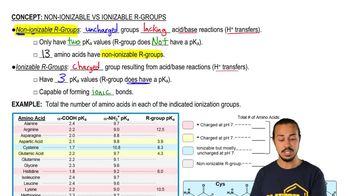
How many pKa values do amino acids with non-ionizable R groups have?
They have two pKa values: one for the amino group and one for the carboxyl group.
How many amino acids have non-ionizable R groups?
There are 13 amino acids with non-ionizable R groups.
How many pKa values do amino acids with ionizable R groups have?
They have three pKa values: one for the amino group, one for the carboxyl group, and one for the R group.
How many amino acids have ionizable R groups?
There are 7 amino acids with ionizable R groups.
Which amino acids have positively charged R groups at physiological pH?
Arginine, histidine, and lysine have positively charged R groups at physiological pH.
Which amino acids have negatively charged R groups at physiological pH?
Aspartate (aspartic acid) and glutamate (glutamic acid) have negatively charged R groups at physiological pH.
Which two amino acids have ionizable R groups but are uncharged at physiological pH?
Cysteine and tyrosine have ionizable R groups but are uncharged at physiological pH.
What is the pKa of cysteine’s R group, and what happens when the pH is above this value?
Cysteine’s R group pKa is 8.3; above this pH, it donates a hydrogen and gains a negative charge.
What is the pKa of tyrosine’s R group, and what happens when the pH is above this value?
Tyrosine’s R group pKa is 10.1; above this pH, it donates a hydrogen and gains a negative charge.
Why can amino acids with ionizable R groups form ionic bonds?
Because their R groups can gain or lose charges through acid-base reactions, allowing them to participate in ionic interactions.
What mnemonic helps remember the seven amino acids with ionizable R groups?
The mnemonic is 'yucky crazy dragons eat knights riding horses,' representing tyrosine, cysteine, aspartate, glutamate, lysine, arginine, and histidine.
At physiological pH, which ionizable amino acids are uncharged?
Cysteine and tyrosine are uncharged at physiological pH.
What is the significance of understanding ionizable R groups in biochemistry?
It is crucial for understanding charge–charge interactions and protein structure-function relationships.
How do non-ionizable R groups affect an amino acid’s ability to form ionic bonds?
Amino acids with non-ionizable R groups cannot form ionic bonds because their R groups do not gain or lose charges.
 BackBack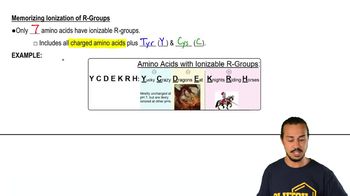
 02:31
02:31