Back

Nucleic Acids 4 quiz

Control buttons has been changed to "navigation" mode.
1/15
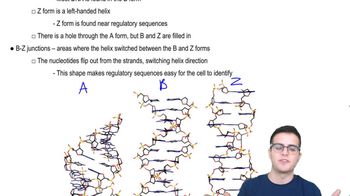
  • What are the three forms of the DNA double helix?

    The three forms are A, B, and Z.
  • Which form of DNA is most common in cells?

    The B form is the most common form of double-stranded DNA in cells.
  • How do the A and B forms of DNA differ in terms of handedness and condensation?

    Both A and B forms are right-handed helices, but the A form is more condensed than the B form.
  • Which nucleic acid typically adopts the A form helix?

    Double-stranded RNA typically adopts the A form helix.
  • What is unique about the Z form of DNA compared to A and B forms?

    The Z form is a left-handed helix, unlike the right-handed A and B forms.
  • Where is the Z form of DNA usually found?

    The Z form is generally found near regulatory sequences in DNA.
  • What are BZ junctions in DNA?

    BZ junctions are areas where the DNA helix switches between the B and Z forms, causing nucleotides to flip out and the helix to change direction.
  • How do BZ junctions affect the shape of DNA?

    BZ junctions cause an abrupt change in the shape of DNA, which can be recognized by cellular machinery.
  • Why is the physical shape of DNA important for cellular function?

    The physical shape and structure of DNA help cells identify regulatory sequences and other important regions.
  • What structural feature is seen when looking down the axis of the A form helix?

    The A form helix has a hollow opening in its center.
  • Do the B and Z forms of DNA have a central opening like the A form?

    No, the B and Z forms do not have a central opening.
  • What forces, in addition to hydrogen bonds, help stabilize the DNA double helix?

    Hydrophobic stacking forces between the bases help stabilize the DNA double helix.
  • Why do hydrophobic stacking forces occur in DNA?

    They occur because the bases are hydrophobic and stack on top of each other in the center of the helix.
  • What surrounds the outside of the DNA double helix?

    The outside of the DNA helix is surrounded by phosphate groups and is stabilized by water in the aqueous cellular environment.
  • How do hydrophobic stacking forces and the aqueous environment together stabilize DNA?

    Hydrophobic stacking forces stabilize the interior of the helix, while water and phosphate groups stabilize the exterior.