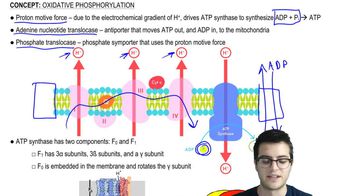
What role does ATP synthase play in oxidative phosphorylation?
ATP synthase uses the protonmotive force generated by the electron transport chain to synthesize ATP from ADP and inorganic phosphate during oxidative phosphorylation.
What is the function of ATP synthase in mitochondria?
ATP synthase functions as a molecular motor that couples the flow of protons down their electrochemical gradient to the synthesis and release of ATP from ADP and inorganic phosphate.
Which enzyme is responsible for converting ADP and inorganic phosphate into ATP during oxidative phosphorylation?
ATP synthase is the enzyme that catalyzes the conversion of ADP and inorganic phosphate into ATP during oxidative phosphorylation.
How does ATP synthase produce ATP?
ATP synthase produces ATP by rotating its gamma subunit, which induces conformational changes in the beta subunits, allowing them to bind ADP and inorganic phosphate, synthesize ATP, and release it, all powered by the protonmotive force.
What is the main purpose of electron transport in mitochondria?
The main purpose is to build a proton gradient, known as the protonmotive force. This gradient powers ATP synthase to produce ATP.
How does ADP enter the mitochondrial matrix for ATP synthesis?
ADP enters the matrix through an antiporter called adenine nucleotide translocase. This transporter exchanges ADP in for ATP out across the inner mitochondrial membrane.
What mechanism does phosphate translocase use to import inorganic phosphate into the mitochondrial matrix?
Phosphate translocase acts as a symporter, bringing inorganic phosphate into the matrix along with a proton. It utilizes the proton gradient created by electron transport.
Which subunit of ATP synthase acts as a driveshaft to induce conformational changes in the enzyme?
The gamma subunit acts as a driveshaft, transmitting rotational energy from the F0 portion to the F1 portion. This rotation causes conformational changes in the alpha and beta subunits.
What are the three conformational states of the beta subunits in ATP synthase?
The beta subunits cycle through open, loose, and tight conformations. Each state is associated with binding, synthesis, or release of ATP and its substrates.
During ATP synthesis, which step requires the most energy from the protonmotive force?
The release of tightly bound ATP from the beta subunit requires the most energy. This energy is provided by the shift from the tight state to the open state.