Back

Passive Membrane Transport definitions

Control buttons has been changed to "navigation" mode.
1/15
  • Passive Transport

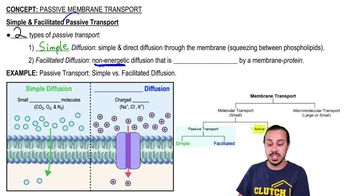
    Movement of molecules across membranes without energy input, driven by concentration gradients.
  • Lipid Bilayer

    Double-layered structure forming cell membranes, composed of phospholipids, allowing selective permeability.
  • Simple Diffusion

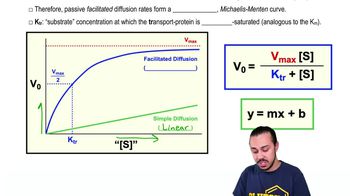
    Direct movement of small, nonpolar molecules through phospholipids, increasing linearly with concentration.
  • Facilitated Diffusion

    Transport of larger or charged molecules via membrane proteins, exhibiting saturation at high concentrations.
  • Phospholipid

    Molecule forming the basic structure of cell membranes, enabling selective passage of substances.
  • Membrane Transport Protein

    Protein embedded in membranes, enabling passage of specific molecules without energy expenditure.
  • Concentration Gradient

    Difference in substance concentration across a membrane, driving passive movement from high to low.
  • Vmax

    Maximum rate of facilitated diffusion, determined by the availability of transport proteins.
  • Michaelis-Menten Curve

    Hyperbolic graph describing facilitated diffusion kinetics, showing saturation as substrate concentration increases.
  • Ktr

    Substrate concentration at which transport protein is half saturated, analogous to enzyme kinetics constants.
  • Linear Data

    Graphical representation of simple diffusion, where rate increases proportionally with concentration.
  • Hyperbolic Data

    Graphical pattern of facilitated diffusion, showing rapid increase then plateau as transport proteins saturate.
  • Oxygen

    Small, nonpolar gas molecule capable of crossing membranes via simple diffusion.
  • Carbon Dioxide

    Nonpolar gas molecule that diffuses directly through the lipid bilayer without protein assistance.
  • Nitrogen Gas

    Small, nonpolar molecule able to pass through cell membranes by simple diffusion.