Back

Passive Membrane Transport quiz

Control buttons has been changed to "navigation" mode.
1/15
  • What are the two main types of passive membrane transport?

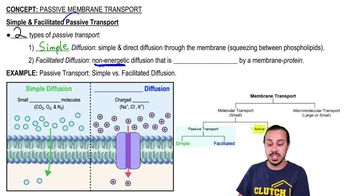
    The two main types are simple diffusion and facilitated diffusion.
  • Does passive membrane transport require energy input?

    No, passive membrane transport does not require energy input.
  • How do molecules move in passive transport relative to their concentration gradient?

    Molecules move down their concentration gradient, from high to low concentration.
  • What type of molecules typically use simple diffusion to cross the membrane?

    Small, nonpolar molecules like oxygen, carbon dioxide, and nitrogen gas use simple diffusion.
  • What is required for facilitated diffusion that is not needed for simple diffusion?

    Facilitated diffusion requires a membrane transport protein.
  • Why can't charged molecules cross the membrane by simple diffusion?

    Charged molecules cannot cross the hydrophobic core of the membrane without facilitation by a protein.
  • How does the rate of simple diffusion change with increasing concentration of the diffusing substance?

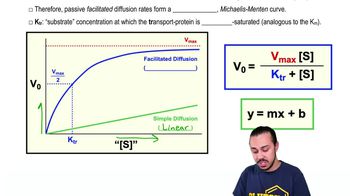
    The rate of simple diffusion increases linearly with increasing concentration.
  • What kind of graph does simple diffusion produce when plotting rate versus concentration?

    Simple diffusion produces a straight, linear line on such a graph.
  • How does the rate of facilitated diffusion compare to simple diffusion at the same concentration?

    Facilitated diffusion is faster than simple diffusion at any given concentration.
  • What limits the maximum rate (Vmax) of facilitated diffusion?

    The maximum rate is limited by the number of available transport proteins in the membrane.
  • What shape does the rate versus concentration curve for facilitated diffusion have?

    Facilitated diffusion shows a hyperbolic, Michaelis-Menten type curve.
  • What is the Michaelis-Menten-like equation for facilitated diffusion?

    The equation is v = Vmax[S]/(Ktr + [S]), where Ktr is the substrate concentration at half saturation.
  • What does Ktr represent in the context of facilitated diffusion?

    Ktr is the substrate concentration at which the transport protein is half saturated.
  • How can a biochemist distinguish between simple and facilitated diffusion using a graph?

    By plotting rate versus concentration: a linear plot indicates simple diffusion, while a hyperbolic curve indicates facilitated diffusion.
  • Is ATP used in either simple or facilitated diffusion?

    No, neither simple nor facilitated diffusion uses ATP or any energy input.