Back

Peptide Mass Fingerprinting quiz

Control buttons has been changed to "navigation" mode.
1/15
  • What is the main purpose of peptide mass fingerprinting (PMF)?

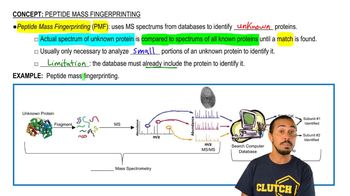
    PMF is used to identify unknown proteins by comparing their mass spectrometry spectra to those in a database.
  • What technique is central to peptide mass fingerprinting for analyzing proteins?

    Tandem mass spectrometry (MSMS) is central to PMF for generating unique spectra of protein fragments.
  • How does PMF speed up the identification process of unknown proteins?

    It only requires analysis of small portions of the protein rather than the entire protein.
  • What must be true about the database for PMF to successfully identify a protein?

    The database must already contain the protein; otherwise, the protein cannot be identified using PMF.
  • What happens if the unknown protein is not found in the database during PMF?

    It may indicate the discovery of a new protein, which can then be sequenced and added to the database.
  • What is the first step in the PMF process after obtaining a purified protein?

    The protein is fragmented using a chemical or protease to generate peptide fragments.
  • What is the role of the first mass spectrometry in PMF?

    It acts as a filter to select specific peptide fragments for further analysis.
  • What does tandem mass spectrometry (MSMS) generate in the PMF process?

    It generates unique spectra for selected peptide fragments, which act as fingerprints.
  • Why are the spectra generated by MSMS compared to fingerprints?

    Because they are unique to each peptide fragment, allowing for specific identification in a database.
  • How are the MSMS spectra used to identify the unknown protein?

    They are entered into a computer database and matched to known spectra linked to protein sequences.
  • What information is obtained once a spectrum is matched in the database?

    The actual protein sequence for the peptide fragment is identified, leading to identification of the original protein.
  • What is a limitation of PMF regarding novel proteins?

    PMF cannot identify proteins not present in the database, so new proteins require full sequencing.
  • What is the significance of matching spectra to protein sequences in PMF?

    It allows for the identification of the protein subunits and ultimately the unknown protein.
  • What is the main advantage of using PMF over sequencing the entire protein?

    It is faster because only small fragments need to be analyzed rather than the whole protein.
  • What happens after a new protein is fully sequenced and added to the database?

    Future identifications of the same protein can be done quickly using PMF.