Back

Phosphorylation definitions

Control buttons has been changed to "navigation" mode.
1/15
  • Phosphorylation

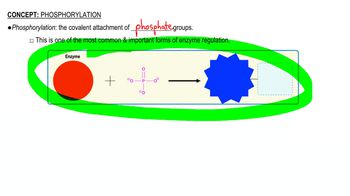
    Covalent attachment of a phosphate group to a protein, altering its activity and conformation for regulation.
  • Post-translational modification

    Chemical alteration of proteins after synthesis, impacting their function, stability, or localization.
  • Phosphate group

    Negatively charged chemical moiety added to proteins, increasing polarity and enabling charge interactions.
  • ATP

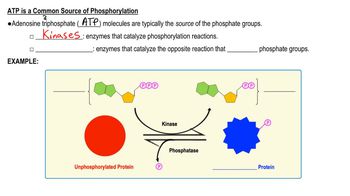
    High-energy molecule with three phosphate groups, commonly donating a phosphate during protein modification.
  • ADP

    Molecule formed after ATP loses a phosphate group, containing two phosphates and lower energy.
  • Kinase

    Enzyme catalyzing the addition of phosphate groups to proteins, often using ATP as a co-substrate.
  • Phosphatase

    Enzyme responsible for removing phosphate groups from proteins, reversing regulatory modifications.
  • Serine

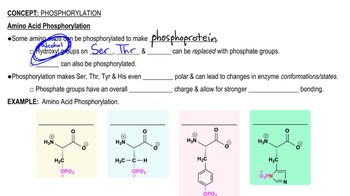
    Amino acid with a hydroxyl group, frequently targeted for phosphate attachment in eukaryotic cells.
  • Threonine

    Amino acid possessing a hydroxyl group, commonly modified by phosphorylation in proteins.
  • Tyrosine

    Amino acid with a hydroxyl group, susceptible to phosphorylation, affecting protein activity.
  • Histidine

    Amino acid occasionally phosphorylated, mainly in prokaryotes and plants, less so in humans.
  • Phosphoprotein

    Protein that has undergone phosphorylation, often playing a role in cellular regulation.
  • Hydroxyl group

    Functional group in certain amino acids, replaced by phosphate during phosphorylation.
  • Polarity

    Property increased in amino acids after phosphate addition, influencing protein conformation.
  • Conformation

    Three-dimensional shape of a protein, altered by phosphorylation to regulate function.