Back

Practice: Amino Acid Oxidation 2 quiz

Control buttons has been changed to "navigation" mode.
1/15
  • Which amino acids are classified as both glucogenic and ketogenic?

    Some amino acids are both glucogenic and ketogenic, meaning they can give rise to both glucose and ketone bodies.
  • What do all amino acids generate during their catabolism?

    All amino acids generate urea as a waste product during their catabolism.
  • Which molecule interacts directly with complex 2 of the electron transport chain?

    FAD (flavin adenine dinucleotide) interacts directly with complex 2, not amino acids.
  • What is the role of FAD in the electron transport chain?

    FAD acts as a cofactor for complex 2 in the electron transport chain, facilitating electron transfer.
  • What cofactor is required for all amino acid degradation pathways?

    The cofactor required is involved in the first transamination step of amino acid degradation.
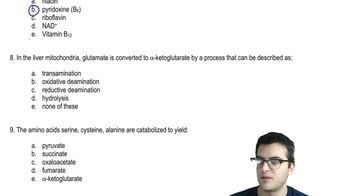
  • Where does the conversion of glutamate to alpha-ketoglutarate occur in the cell?

    This conversion occurs in the liver mitochondria.
  • What is the process called when glutamate is converted to alpha-ketoglutarate?

    The process is called oxidative deamination.
  • Which amino acids are catabolized to yield pyruvate?

    Serine, cysteine, and alanine are catabolized to yield pyruvate.
  • How are serine, cysteine, and alanine classified based on their catabolic products?

    They are classified as glucogenic amino acids because they yield pyruvate.
  • What genetic disease results from the inability to convert phenylalanine to tyrosine?

    Phenylketonuria (PKU) results from this metabolic defect.
  • Which enzyme is defective in phenylketonuria?

    The first enzyme in the pathway converting phenylalanine to tyrosine is defective in PKU.
  • What compound is used as a marker to screen babies for phenylketonuria?

    Phenylacetate is used as a marker for phenylalanine conversion issues.
  • Why are infants with phenylketonuria placed on a low phenylalanine diet?

    To prevent developmental problems during early brain development.
  • When is it most critical to manage phenylalanine intake in infants with PKU?

    It is most critical during the early years when the brain is still developing.
  • What is the main purpose of screening newborns for phenylacetate?

    Screening for phenylacetate helps identify infants with PKU to prevent developmental issues.