Back

Practice - Glycolysis 1 definitions

Control buttons has been changed to "navigation" mode.
1/15
  • Glycolysis

    Metabolic pathway converting glucose to pyruvate, generating ATP and NADH, and serving as a primary energy source under anaerobic conditions.
  • Fructose 1,6-bisphosphate

    Intermediate in glycolysis formed by phosphofructokinase, whose conversion to pyruvate yields increased ATP and NADH compared to glucose.
  • Pyruvate

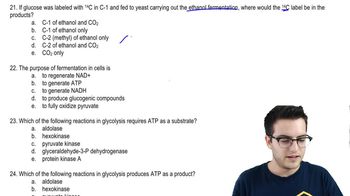
    Three-carbon end product of glycolysis, whose methyl carbon can be traced from glucose using carbon-14 labeling.
  • NADH

    Reduced electron carrier produced during glycolysis, essential for energy production and regenerated during fermentation.
  • ATP

    Energy currency molecule generated and consumed during glycolysis, with net production dependent on the starting substrate.
  • Hexokinase

    Enzyme catalyzing the first step of glycolysis, phosphorylating glucose using ATP to form glucose-6-phosphate.
  • Phosphofructokinase

    Enzyme responsible for converting fructose 6-phosphate to fructose 1,6-bisphosphate, consuming ATP in glycolysis.
  • Aldolase

    Enzyme splitting fructose 1,6-bisphosphate into dihydroxyacetone phosphate and glyceraldehyde-3-phosphate without ATP involvement.
  • Pyruvate kinase

    Enzyme catalyzing the final step of glycolysis, producing ATP by transferring a phosphate group to ADP.
  • Glyceraldehyde-3-phosphate dehydrogenase

    Enzyme converting glyceraldehyde-3-phosphate to 1,3-bisphosphoglycerate, using inorganic phosphate and generating NADH.
  • Triose phosphate isomerase

    Enzyme facilitating ketose to aldose isomerization, converting dihydroxyacetone phosphate to glyceraldehyde-3-phosphate.
  • Dihydroxyacetone phosphate

    Three-carbon glycolytic intermediate produced by aldolase, converted to glyceraldehyde-3-phosphate by triose phosphate isomerase.
  • Glyceraldehyde-3-phosphate

    Aldose sugar formed in glycolysis, serving as a substrate for further energy-yielding reactions and NADH production.
  • Fermentation

    Anaerobic process regenerating NAD+ from NADH, enabling continued glycolysis when oxygen is limited.
  • Acetaldehyde

    Intermediate formed from pyruvate during ethanol fermentation, reduced to ethanol by NADH.