Back

Practice - Glycolysis 1 quiz

Control buttons has been changed to "navigation" mode.
1/15
  • How many moles of NADH and ATP are produced when one mole of fructose 1,6-bisphosphate is converted to pyruvate in glycolysis?

    Converting one mole of fructose 1,6-bisphosphate to pyruvate yields 2 moles of NADH and 4 moles of ATP.
  • Why does glycolysis starting from glucose yield only 2 moles of ATP, compared to 4 moles when starting from fructose 1,6-bisphosphate?

    Starting from glucose, 2 ATP are consumed in early steps, resulting in a net gain of only 2 ATP.
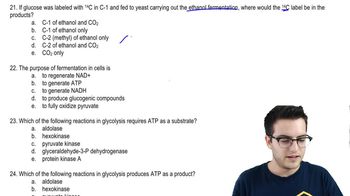
  • Which enzyme in glycolysis is the first to use ATP as a substrate?

    Hexokinase is the first enzyme in glycolysis to use ATP, phosphorylating glucose to glucose-6-phosphate.
  • What is the main purpose of fermentation in cells?

    Fermentation regenerates NAD+ from NADH, allowing glycolysis to continue in low or no oxygen conditions.
  • Which glycolytic enzyme produces ATP as a product?

    Pyruvate kinase produces ATP during the conversion of phosphoenolpyruvate to pyruvate.
  • What is the substrate and product of the aldolase reaction in glycolysis?

    Aldolase splits fructose 1,6-bisphosphate into dihydroxyacetone phosphate (DHAP) and glyceraldehyde-3-phosphate (G3P).
  • Which glycolytic enzyme catalyzes a ketose to aldose isomerization?

    Triose phosphate isomerase converts dihydroxyacetone phosphate (DHAP, a ketose) to glyceraldehyde-3-phosphate (G3P, an aldose).
  • What molecule is labeled if glucose labeled with carbon-14 at C1 and C6 is metabolized to pyruvate?

    The methyl carbon of pyruvate will be labeled with carbon-14, corresponding to C1 or C6 from glucose.
  • During ethanol fermentation, where does the carbon-14 label from glucose C1 end up in ethanol?

    The carbon-14 label from glucose C1 ends up at the C2 (methyl) position of ethanol.
  • Which glycolytic enzyme uses inorganic phosphate, not ATP, to phosphorylate its substrate?

    Glyceraldehyde-3-phosphate dehydrogenase uses inorganic phosphate to phosphorylate G3P, not ATP.
  • What is the fate of the carbon atom lost as CO2 during ethanol fermentation from pyruvate?

    The carbon lost as CO2 is either carbon 3 or 4 from glucose, which is removed during decarboxylation.
  • Why can't glycolysis continue indefinitely without fermentation under anaerobic conditions?

    Without fermentation, NAD+ would be depleted as it is converted to NADH, halting glycolysis.
  • Which glycolytic enzyme does NOT use ATP as a substrate: hexokinase, aldolase, or pyruvate kinase?

    Aldolase and pyruvate kinase do not use ATP as a substrate; only hexokinase does.
  • What are the products of the aldolase reaction in glycolysis?

    The products are dihydroxyacetone phosphate (DHAP) and glyceraldehyde-3-phosphate (G3P).
  • What is the role of NAD+ in glycolysis and fermentation?

    NAD+ acts as an electron acceptor in glycolysis and is regenerated during fermentation to sustain glycolysis.