Back

Practice - Nucleic Acids 3 quiz

Control buttons has been changed to "navigation" mode.
1/15
  • What is the difference between a nucleoside and a nucleotide?

    A nucleoside consists of a sugar (ribose or deoxyribose) linked to a base, while a nucleotide also includes one or more phosphate groups.
  • What is the name of the nucleoside formed by ribose and adenine?

    The nucleoside formed by ribose and adenine is called adenosine.
  • Why is adenosine not considered a nucleotide?

    Adenosine lacks a phosphate group, which is required for a molecule to be classified as a nucleotide.
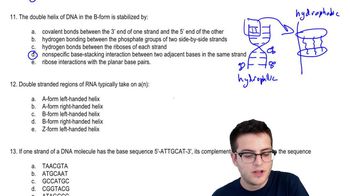
  • What type of interaction primarily stabilizes the DNA double helix?

    The DNA double helix is primarily stabilized by nonspecific base stacking interactions between adjacent bases.
  • What role do hydrophilic interactions with water play in DNA structure?

    Hydrophilic interactions with water stabilize the outside of the DNA helix by interacting with the negatively charged phosphate groups.
  • Which form does double-stranded RNA typically adopt?

    Double-stranded RNA typically adopts the A form helix.
  • What is the most common form of DNA found in cells?

    The most common form of DNA in cells is the B form helix.
  • What is unique about the Z form of DNA?

    The Z form of DNA is left-handed and is often found in regulatory sequences.
  • Why is it important to write DNA strands from 5' to 3'?

    Writing DNA strands from 5' to 3' is crucial for correctly determining complementary strands and understanding DNA replication.
  • What happens to DNA when it is heated to 95°C?

    Heating DNA to 95°C causes denaturation, breaking the hydrogen bonds between bases and separating the strands.
  • Do covalent bonds in DNA break during denaturation at 95°C?

    No, covalent bonds in DNA remain intact during denaturation at 95°C; only hydrogen bonds between bases are broken.
  • What is the role of dideoxy CTP in Sanger sequencing?

    Dideoxy CTP terminates the formation of the complementary DNA strand, resulting in fragments of varying lengths for analysis.
  • Why are dideoxynucleotides used at low concentrations in Sanger sequencing?

    Dideoxynucleotides are used at low concentrations to ensure that synthesis is only occasionally terminated, producing a range of fragment lengths.
  • How are DNA fragments identified in Sanger sequencing?

    DNA fragments are identified using radioactively labeled dideoxynucleotides, which allow visualization on gels.
  • What is the difference in concentration between dNTPs and ddNTPs in Sanger sequencing?

    dNTPs are present at millimolar concentrations, while ddNTPs are present at much lower, micromolar concentrations.