Back

Primary Active Membrane Transport quiz

Control buttons has been changed to "navigation" mode.
1/15
  • What is the main difference between active and passive transport?

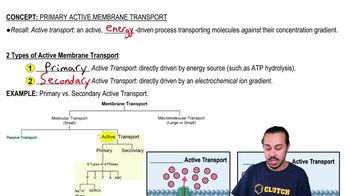
    Active transport requires energy to move molecules against their concentration gradient, while passive transport does not require energy and moves molecules down their gradient.
  • What energy source directly drives primary active transport?

    Primary active transport is directly driven by ATP hydrolysis.
  • How does secondary active transport differ from primary active transport?

    Secondary active transport is driven by electrochemical ion gradients, not directly by ATP hydrolysis.
  • What is the main function of primary active transport ATPases?

    They hydrolyze ATP to transport molecules across membranes against their concentration gradient.
  • How many main types of primary active transport ATPases are there?

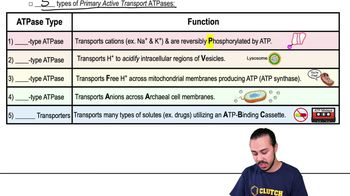
    There are five main types: P-type, V-type, F-type, A-type, and ABC transporters.
  • What do P-type ATPases transport and what is their defining feature?

    P-type ATPases transport cations like sodium and potassium and are reversibly phosphorylated by ATP.
  • Which ATPase is involved in acidifying vesicles such as lysosomes?

    V-type ATPases transport hydrogen ions to acidify vesicles, playing a role in lysosome function.
  • What is the function of F-type ATPases?

    F-type ATPases, also known as ATP synthases, produce ATP by transporting hydrogen ions across mitochondrial membranes.
  • Which type of ATPase transports anions across archaeal cell membranes?

    A-type ATPases transport anions across archaeal cell membranes.
  • What do ABC transporters move across membranes?

    ABC transporters move various solutes, including drugs and toxins, using an ATP binding cassette.
  • What does the 'ase' suffix in ATPase indicate?

    The 'ase' suffix indicates that ATPases are enzymes.
  • What is the role of the sodium-potassium pump in primary active transport?

    The sodium-potassium pump is a P-type ATPase that transports sodium and potassium ions against their concentration gradients.
  • How do V-type ATPases contribute to lysosome function?

    V-type ATPases acidify lysosomes by transporting hydrogen ions into them.
  • What is the unique feature of F-type ATPases compared to other ATPases?

    F-type ATPases synthesize ATP instead of hydrolyzing it, by moving hydrogen ions across mitochondrial membranes.
  • What mechanism do ABC transporters use to transport solutes?

    ABC transporters use an ATP binding cassette to transport solutes across membranes.