Back

Protein-Ligand Equilibrium Constants definitions

Control buttons has been changed to "navigation" mode.
1/15
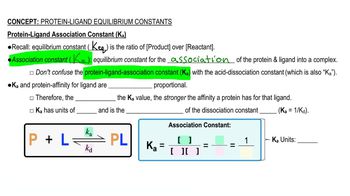
  • Association Constant

    Quantifies the strength of interaction between a protein and ligand; higher values indicate greater affinity and are expressed in units of inverse molarity.
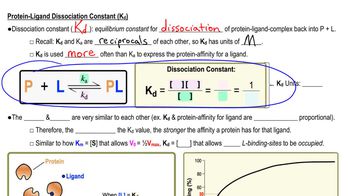
  • Dissociation Constant

    Reflects the tendency of a protein-ligand complex to separate; lower values signify stronger binding and are measured in molarity.
  • Affinity

    Describes how strongly a protein binds to its ligand; directly related to association constant and inversely to dissociation constant.
  • Equilibrium Constant

    Represents the ratio of product to reactant concentrations at equilibrium for protein-ligand interactions.
  • Rate Constant

    Indicates the speed of association or dissociation in protein-ligand reactions, distinct from equilibrium constants.
  • Inverse Molarity

    Unit used for association constant, challenging to interpret compared to molarity, and signifies concentration reciprocals.
  • Molarity

    Unit for dissociation constant, representing concentration and facilitating easier interpretation in protein-ligand studies.
  • Protein-Ligand Complex

    Formed when a protein and ligand bind together, central to equilibrium and affinity measurements.
  • Michaelis Constant

    Value indicating substrate concentration at which enzyme activity reaches half its maximum; analogous to dissociation constant.
  • Binding Site

    Region on a protein where a ligand attaches; occupancy is used to assess affinity and equilibrium constants.
  • Reciprocal Relationship

    Describes how association and dissociation constants are mathematical inverses, linking their values and interpretations.
  • Product

    Resulting species in equilibrium equations, such as the protein-ligand complex or free protein and ligand after dissociation.
  • Reactant

    Initial species in equilibrium equations, including free protein, free ligand, or protein-ligand complex depending on direction.
  • Ligand Concentration

    Amount of ligand present; at dissociation constant value, half of protein binding sites are occupied.
  • Occupancy

    Fraction of protein binding sites filled by ligand, reaching 50% when ligand concentration equals dissociation constant.