Back

PSP Secondary Messengers & PKC definitions

Control buttons has been changed to "navigation" mode.
1/15
  • Phosphoinositide

    A membrane lipid serving as a substrate for phospholipase C, initiating secondary messenger production in GPCR signaling.
  • GPCR

    A membrane receptor that activates intracellular signaling cascades via G proteins, leading to diverse cellular responses.
  • Phospholipase C

    An effector enzyme that hydrolyzes PIP2, generating IP3 and DAG as secondary messengers in signaling pathways.
  • PIP2

    A phospholipid in the plasma membrane cleaved by phospholipase C to produce IP3 and DAG during signal transduction.
  • IP3

    A soluble secondary messenger that diffuses to the endoplasmic reticulum, triggering calcium release into the cytoplasm.
  • DAG

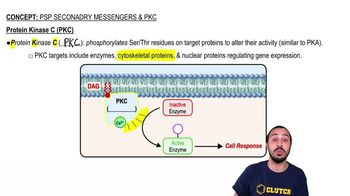
    A membrane-bound secondary messenger that, together with calcium, activates protein kinase C to modulate cell activity.
  • Endoplasmic Reticulum

    An organelle whose membrane contains calcium channels opened by IP3, facilitating calcium release into the cytoplasm.
  • Calcium

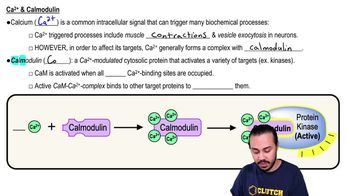
    An intracellular ion released from the endoplasmic reticulum, essential for activating calmodulin and kinases.
  • Calmodulin

    A cytosolic protein with four calcium binding sites, forming a complex that activates various target proteins.
  • Protein Kinase C

    A serine/threonine kinase activated by DAG and calcium, phosphorylating target proteins to regulate cellular responses.
  • Serine/Threonine Kinase

    An enzyme class that modifies proteins by adding phosphate groups to serine or threonine residues, altering their activity.
  • Phosphatase

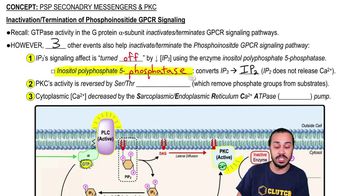
    An enzyme that removes phosphate groups from substrates, reversing phosphorylation and terminating signaling events.
  • Inositol Polyphosphate 5-Phosphatase

    An enzyme converting IP3 to IP2, preventing calcium release and contributing to signal termination in the pathway.
  • SERCA Pump

    A membrane ATPase transporting calcium from the cytoplasm back into the endoplasmic reticulum, restoring basal levels.
  • GTPase

    A protein domain in G protein alpha subunits that hydrolyzes GTP, resetting and terminating GPCR signaling.