Back

PSP Secondary Messengers & PKC quiz

Control buttons has been changed to "navigation" mode.
1/15
  • What enzyme catalyzes the hydrolysis of PIP2 in the phosphoenositide GPCR signaling pathway?

    Phospholipase C (PLC) catalyzes the hydrolysis of PIP2, producing IP3 and DAG as secondary messengers.
  • What are the two secondary messengers produced from PIP2 hydrolysis?

    The hydrolysis of PIP2 produces inositol triphosphate (IP3) and diacylglycerol (DAG).
  • Where does IP3 diffuse after its formation, and what is its primary action?

    IP3 diffuses to the endoplasmic reticulum and binds to calcium ion channels, triggering calcium release into the cytoplasm.
  • What happens to DAG after it is produced from PIP2 hydrolysis?

    DAG remains associated with the plasma membrane and activates protein kinase C (PKC) in the presence of calcium.
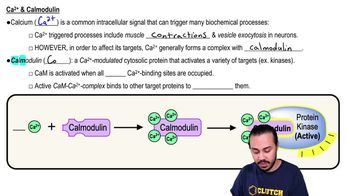
  • How does calcium act as a secondary messenger in the PSP pathway?

    Calcium is released into the cytoplasm by IP3 and forms a complex with calmodulin to activate various kinases.
  • What is calmodulin and how is it activated?

    Calmodulin is a calcium-modulated cytosolic protein activated when all four of its calcium binding sites are occupied.
  • What is the function of the calcium-calmodulin complex?

    The calcium-calmodulin complex binds to and activates target proteins, such as kinases, to modulate cellular responses.
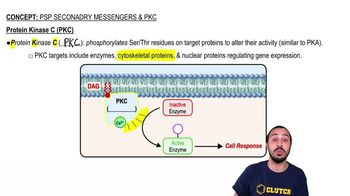
  • What type of kinase is protein kinase C (PKC), and what residues does it phosphorylate?

    PKC is a serine/threonine kinase that phosphorylates serine and threonine residues on target proteins.
  • What cellular responses can PKC regulate?

    PKC can regulate enzymes, cytoskeletal proteins, and nuclear proteins, affecting gene expression and various cell responses.
  • What two molecules are required for PKC activation?

    PKC is activated by DAG and calcium, which together induce its active conformation.
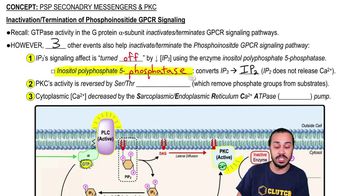
  • How is the signal terminated in the phosphoenositide GPCR pathway?

    Signal termination involves GTPase activity, phosphatases reversing phosphorylation, IP3 dephosphorylation, and calcium reuptake by the SERCA pump.
  • What enzyme converts IP3 into IP2, and what is the effect of this conversion?

    Inositol polyphosphate 5-phosphatase converts IP3 into IP2, which does not release calcium, thus terminating the signal.
  • How is PKC activity reversed during signal termination?

    PKC activity is reversed by serine/threonine phosphatases, which remove phosphate groups from PKC's target proteins.
  • What is the role of the SERCA pump in the PSP pathway?

    The SERCA pump transports calcium from the cytoplasm back into the endoplasmic reticulum, lowering cytoplasmic calcium levels.
  • Why is phosphorylation not always associated with activation of target proteins?

    Phosphorylation alters the activity of target proteins, which can lead to either activation or inhibition depending on the context.