Back

Rate Constant Units quiz

Control buttons has been changed to "navigation" mode.
1/15
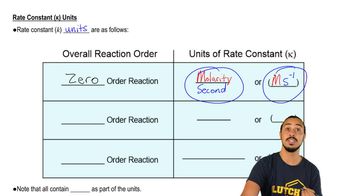
  • What determines the units of the rate constant k in a reaction?

    The overall reaction order determines the units of the rate constant k.
  • What are the units of the rate constant k for a zero order reaction?

    The units are molarity per second (M/s) for a zero order reaction.
  • How are the units for zero order reactions expressed in terms of exponents?

    They are expressed as M^1 s^-1, which sums to zero, indicating zero order.
  • What are the units of the rate constant k for a first order reaction?

    The units are inverse seconds (1/s) for a first order reaction.
  • How are the units for first order reactions expressed in terms of exponents?

    They are expressed as s^-1, which indicates first order.
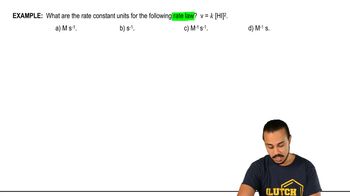
  • What are the units of the rate constant k for a second order reaction?

    The units are inverse molarity times seconds (1/M·s) for a second order reaction.
  • How are the units for second order reactions expressed in terms of exponents?

    They are expressed as M^-1 s^-1, which sums to -2, indicating second order.
  • What common unit is present in all rate constant units regardless of reaction order?

    Inverse seconds (s^-1) are present in all rate constant units.
  • Why is it helpful to remember that all rate constant units contain inverse seconds?

    It helps in memorizing and identifying the units for different reaction orders.
  • How can you use the sum of exponents in the units to identify reaction order?

    The sum of the exponents in the units corresponds to the overall reaction order.
  • What is the significance of molarity in the units of the rate constant?

    Molarity indicates the concentration dependence in the rate constant units.
  • How do the units for zero order and second order reactions differ?

    Zero order units are M/s, while second order units are 1/(M·s).
  • What does the unit 1/s imply about the reaction order?

    It implies the reaction is first order.
  • How can you convert molarity per second to molarity times inverse seconds?

    M/s is equivalent to M·s^-1, just written differently.
  • Why is understanding rate constant units important in biochemistry?

    It is essential for interpreting rate equations and reaction kinetics in biochemical processes.