Back

Reaction Orders definitions

Control buttons has been changed to "navigation" mode.
1/15
  • Rate Law

    Mathematical expression relating reaction velocity to rate constant and reactant concentrations raised to their respective orders.
  • Reaction Order

    Exponent indicating how a reactant's concentration affects the reaction rate; determined experimentally except in elementary reactions.
  • Elementary Reaction

    Single-step process with one transition state where substrate coefficients match reaction orders.
  • Non Elementary Reaction

    Multi-step process with intermediates; substrate coefficients do not necessarily match reaction orders.
  • Overall Reaction Order

    Sum of individual reaction orders for all substrates in a reaction, indicating total dependence on reactant concentrations.
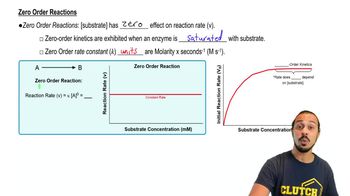
  • Zero Order Reaction

    Type where reaction rate remains constant regardless of changes in substrate concentration, often due to enzyme saturation.
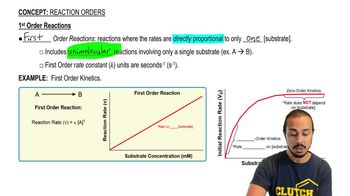
  • First Order Reaction

    Type where reaction rate is directly proportional to the concentration of a single substrate, typically in unimolecular processes.
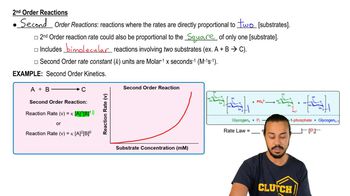
  • Second Order Reaction

    Type where reaction rate depends on two substrate concentrations or the square of one, often seen in bimolecular reactions.
  • Pseudo First Order Reaction

    Second order process appearing as first order due to one substrate being in large excess, masking true reaction dependence.
  • Substrate

    Reactant in an enzyme-catalyzed reaction whose concentration can influence reaction rate depending on reaction order.
  • Transition State

    High-energy intermediate in a reaction pathway; elementary reactions feature only one of these.
  • Limiting Reagent

    Reactant present in the smallest amount, dictating the maximum possible reaction rate in pseudo first order scenarios.
  • Bimolecular Reaction

    Process involving two reactant molecules, characteristic of many second order reactions.
  • Enzyme Saturation

    Condition where all enzyme active sites are occupied, resulting in zero order kinetics.
  • Rate Constant

    Proportionality factor in the rate law, with units varying by reaction order, reflecting intrinsic reaction speed.