Back

Reaction Orders quiz

Control buttons has been changed to "navigation" mode.
1/15
  • What is the reaction order in a rate law, and how is it determined?

    The reaction order is the exponent to which a reactant concentration is raised in the rate law, showing how the rate depends on that reactant. It must be determined experimentally except for elementary reactions, where it matches the substrate coefficient.
  • When do substrate coefficients equal reaction orders in a reaction?

    Substrate coefficients equal reaction orders only in elementary reactions, which have a single transition state.
  • How is the overall reaction order of a reaction calculated?

    The overall reaction order is the sum of the individual reaction orders for all substrates in the reaction.
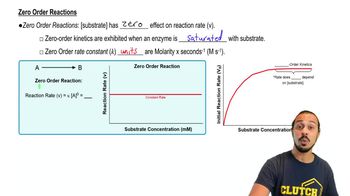
  • What characterizes a zero order reaction?

    In a zero order reaction, the reaction rate is independent of the substrate concentration, meaning changes in substrate concentration do not affect the rate.
  • Under what condition do enzyme-catalyzed reactions display zero order kinetics?

    Enzyme-catalyzed reactions display zero order kinetics when the enzyme is saturated with substrate.
  • What does the rate law for a zero order reaction look like?

    The rate law for a zero order reaction is rate = k, where k is the rate constant, because the substrate concentration is raised to the zero power.
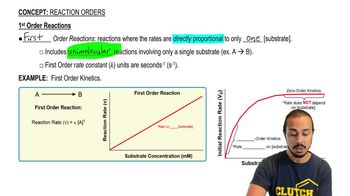
  • How does the reaction rate change with substrate concentration in a first order reaction?

    In a first order reaction, the reaction rate is directly proportional to the concentration of a single substrate.
  • What is a unimolecular reaction, and which reaction order does it typically follow?

    A unimolecular reaction involves only one molecule as a reactant and typically follows first order kinetics.
  • How does the graph of reaction rate versus substrate concentration appear for a zero order reaction?

    The graph is a horizontal line, indicating that the reaction rate remains constant regardless of substrate concentration.
  • How does the graph of reaction rate versus substrate concentration appear for a first order reaction?

    The graph is a straight, diagonal line with a positive slope, showing that the rate increases linearly with substrate concentration.
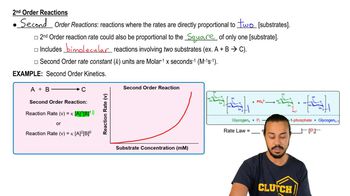
  • What are the two common forms of the rate law for a second order reaction?

    The rate law for a second order reaction can be rate = k[A][B] (two substrates) or rate = k[A]^2 (the square of one substrate's concentration).
  • What is a bimolecular reaction, and which reaction order does it typically follow?

    A bimolecular reaction involves two reactant molecules and typically follows second order kinetics.
  • How does the reaction rate graph for a second order reaction differ from zero and first order reactions?

    The graph for a second order reaction is a curve that increases more steeply than a straight line, reflecting the rate's dependence on the product or square of substrate concentrations.
  • What is a pseudo first order reaction, and how does it arise?

    A pseudo first order reaction is actually a second order reaction that appears first order because one substrate is present in large excess, making the rate seem dependent only on the limiting substrate.
  • Why must reaction orders for non-elementary reactions be determined experimentally?

    In non-elementary reactions, substrate coefficients do not necessarily match reaction orders, so experimental data is needed to determine the actual reaction orders.