Back

Secondary Active Membrane Transport quiz

Control buttons has been changed to "navigation" mode.
1/15
  • What is the main difference between primary and secondary active transport?

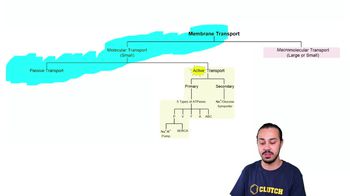
    Primary active transport directly uses ATP hydrolysis for transport, while secondary active transport does not directly use ATP but relies on electrochemical gradients created by primary active transport.
  • How is secondary active transport indirectly driven by ATP hydrolysis?

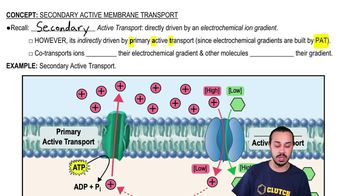
    Secondary active transport depends on electrochemical gradients established by primary active transport, which uses ATP hydrolysis.
  • What creates the electrochemical ion gradients used in secondary active transport?

    Electrochemical ion gradients are created by primary active transport processes.
  • In secondary active transport, which direction do ions move relative to their electrochemical gradient?

    Ions move down their electrochemical gradient, from high to low concentration.
  • What type of process is the movement of ions down their electrochemical gradient in secondary active transport?

    It is a passive, exergonic process.
  • What type of molecules are typically transported against their concentration gradient in secondary active transport?

    Molecules like glucose or amino acids are transported against their concentration gradient.
  • How many molecules are typically co-transported in secondary active transport?

    Two molecules are co-transported at a time.
  • What provides the energy for transporting molecules against their gradient in secondary active transport?

    The energy comes from the passive movement of ions down their electrochemical gradient.
  • Is ATP hydrolysis directly involved in secondary active transport?

    No, ATP hydrolysis is not directly involved in secondary active transport.
  • What is the role of primary active transport in secondary active transport?

    Primary active transport establishes the electrochemical gradients that secondary active transport relies on.
  • What is the direction of transport for the molecule moving against its gradient in secondary active transport?

    It is transported from an area of low concentration to an area of high concentration.
  • What is the direction of transport for the ion moving with its gradient in secondary active transport?

    It moves from an area of high concentration to an area of low concentration.
  • What is the energy-requiring step in secondary active transport?

    The transport of a molecule against its concentration gradient is the energy-requiring, endergonic step.
  • What is an example of secondary active transport mentioned in the lesson?

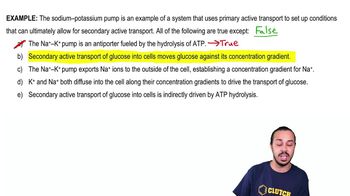
    The sodium-glucose symporter is an example of secondary active transport.
  • Why is secondary active transport considered 'secondary'?

    Because it relies on gradients established by primary active transport, making its energy source indirect.