Back

Steady-State Conditions definitions

Control buttons has been changed to "navigation" mode.
1/14
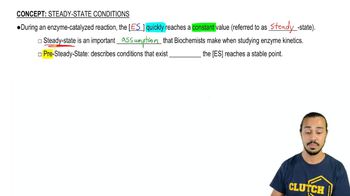
  • Steady State

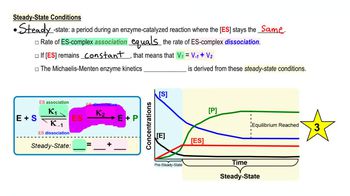
    A period in an enzyme reaction where the concentration of the enzyme-substrate complex remains unchanged, enabling key kinetic assumptions.
  • Pre Steady State

    The initial phase of an enzyme reaction when substrate and enzyme concentrations are high, but enzyme-substrate complex and product are low.
  • Enzyme-Substrate Complex

    A transient molecular assembly formed when an enzyme binds its substrate, central to reaction kinetics.
  • Free Enzyme

    Unbound enzyme molecules available to interact with substrate at the start of a reaction.
  • Free Substrate

    Unbound substrate molecules present in high concentration at the beginning of an enzyme-catalyzed reaction.
  • Product

    The molecule generated from substrate transformation during an enzyme-catalyzed reaction.
  • Association Rate

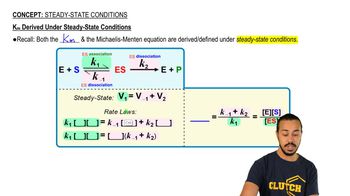
    The velocity at which enzyme and substrate combine to form the enzyme-substrate complex, denoted as v1.
  • Dissociation Rate

    The sum of velocities at which the enzyme-substrate complex breaks apart, either to enzyme and substrate or enzyme and product.
  • Michaelis Constant

    A value derived from steady state assumptions, relating rate constants and concentrations in enzyme kinetics.
  • Rate Law

    An expression linking reaction velocity to rate constants and reactant concentrations in enzyme kinetics.
  • Reaction Velocity

    The speed at which reactants are converted to products in an enzyme-catalyzed process.
  • Michaelis-Menten Equation

    A mathematical model describing enzyme kinetics, derived under steady state conditions.
  • Rate Constant

    A proportionality factor in rate laws, specific to each step in an enzyme-catalyzed reaction.
  • Kinetic Assumption

    A foundational premise, such as steady state, used to simplify and analyze enzyme reaction rates.