Back

Steady-State Conditions quiz

Control buttons has been changed to "navigation" mode.
1/15
  • What is meant by 'steady state' in an enzyme-catalyzed reaction?

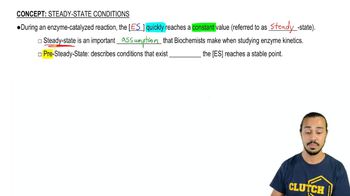
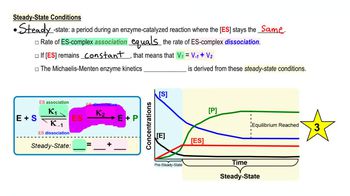
    Steady state refers to the period during which the concentration of the enzyme-substrate complex remains constant.
  • What happens to the concentration of the enzyme-substrate complex during the pre steady state?

    During the pre steady state, the concentration of the enzyme-substrate complex increases until it reaches a constant value.
  • At the very beginning of an enzyme-catalyzed reaction, which concentrations are high and which are low?

    Initially, the concentrations of free substrate and free enzyme are high, while the concentrations of enzyme-substrate complex and product are low.
  • What is the key assumption made under steady state conditions?

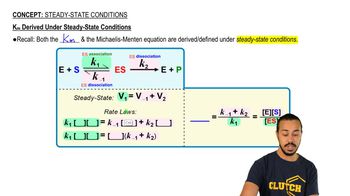
    The key assumption is that the rate of formation of the enzyme-substrate complex equals the rate of its dissociation.
  • How is the rate of dissociation of the enzyme-substrate complex expressed?

    It is the sum of the rates of the backward reaction (v-1) and the forward reaction to product (v2).
  • Why are steady state conditions important for studying enzyme kinetics?

    They allow for the derivation of the Michaelis constant (Km) and the Michaelis-Menten equation.
  • What does the equation v1 = v-1 + v2 represent in the context of steady state?

    It represents the steady state assumption that the rate of enzyme-substrate complex formation equals the total rate of its breakdown.
  • How can reaction velocities be expressed in terms of rate laws?

    Reaction velocities can be written as the product of a rate constant and the concentrations of the reactants involved.
  • What is the rate law for the association of the enzyme-substrate complex?

    It is k1 times the concentration of free enzyme times the concentration of free substrate.
  • How is the Michaelis constant (Km) derived from steady state conditions?

    Km is derived as (k-1 + k2) / k1, based on the rates of association and dissociation of the enzyme-substrate complex.
  • What does the expression [E][S]/[ES] represent under steady state conditions?

    It represents the ratio of free enzyme and substrate concentrations to the enzyme-substrate complex concentration, which equals Km.
  • During steady state, can the concentrations of substrate and product change?

    Yes, the concentrations of substrate and product can change, but the concentration of the enzyme-substrate complex remains constant.
  • What is the significance of the steady state assumption for the Michaelis-Menten equation?

    The steady state assumption is essential for deriving the Michaelis-Menten equation, which describes enzyme kinetics.
  • What happens to the concentrations of free enzyme and substrate during the pre steady state?

    They both decrease over time as the reaction proceeds and the enzyme-substrate complex forms.
  • Why are no enzyme-substrate complex or product present at the start of an enzyme-catalyzed reaction in the lab?

    Because only free enzyme and substrate are added to the reaction mixture initially, so the complex and product start at essentially zero.