Back

Thermodynamics of Membrane Diffusion: Uncharged Molecule quiz

Control buttons has been changed to "navigation" mode.
1/15
  • What type of molecules does this lesson focus on regarding membrane diffusion thermodynamics?

    This lesson focuses on uncharged molecules diffusing across membranes.
  • What equation is central to understanding the thermodynamics of membrane diffusion?

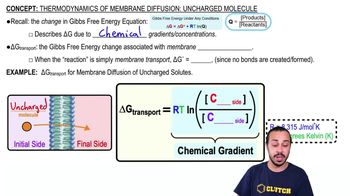
    The change in Gibbs free energy equation, ΔG = ΔG° + RT ln(Q), is central to this topic.
  • What does the reaction quotient Q represent in membrane diffusion?

    Q represents the ratio of the concentration of the molecule on the final side (product) to the initial side (reactant) of the membrane.
  • Why is ΔG° equal to 0 for membrane diffusion of uncharged molecules?

    ΔG° is 0 because no bonds are formed or broken; the molecule remains unchanged during diffusion.
  • How does the ΔG equation simplify for membrane diffusion?

    For membrane diffusion, ΔG transport = RT ln(Q) since ΔG° is zero.
  • What does the term 'ΔG transport' refer to?

    ΔG transport refers to the Gibbs free energy change associated with membrane diffusion.
  • In the context of membrane diffusion, what does the 'product' and 'reactant' refer to?

    The 'product' is the concentration of the molecule on the final side, and the 'reactant' is its concentration on the initial side.
  • What is the value and units of the gas constant R used in these calculations?

    R is 8.315 joules/(moles·K).
  • What unit must temperature be in for membrane diffusion thermodynamics calculations?

    Temperature must be in Kelvin for these calculations.
  • Does the ΔG equation for uncharged molecules account for electrical gradients?

    No, it only describes ΔG due to chemical gradients, not electrical gradients.
  • Why is membrane transport not considered a 'real' reaction in this context?

    Because no bonds are created or broken and the molecule remains the same on both sides of the membrane.
  • What is the mathematical form of ΔG transport for uncharged molecules?

    ΔG transport = RT ln([final]/[initial]), where [final] and [initial] are concentrations on each side of the membrane.
  • What should you do if you do not recognize the Gibbs free energy equation?

    You should review previous lesson videos covering the Gibbs free energy equation.
  • What does the blue background in the equation indicate in the lesson?

    It indicates that the equation describes chemical gradients.
  • What will be shown in the next video according to the transcript?

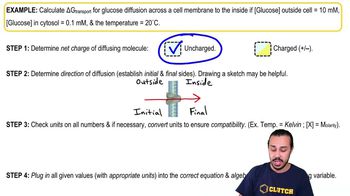
    An example of how to use the ΔG transport equation to calculate membrane diffusion thermodynamics for an uncharged molecule.