Back

Uncompetitive Inhibition definitions

Control buttons has been changed to "navigation" mode.
1/15
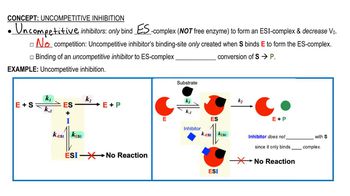
  • Uncompetitive Inhibitor

    Molecule that attaches exclusively to the enzyme-substrate complex, blocking product formation without contesting substrate binding.
  • Enzyme-Substrate Complex

    Intermediate formed when an enzyme binds its substrate, creating a site for uncompetitive inhibitor attachment.
  • ESI Complex

    Structure resulting from an uncompetitive inhibitor binding to the enzyme-substrate complex, halting catalytic activity.
  • Active Site

    Region on an enzyme where substrate binds; uncompetitive inhibitors do not interact with this site directly.
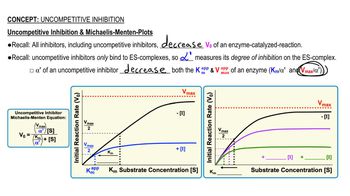
  • Km

    Parameter reflecting substrate affinity; appears lower in the presence of uncompetitive inhibitors due to increased apparent affinity.
  • Vmax

    Maximum reaction rate; reduced proportionally by uncompetitive inhibitors, regardless of substrate concentration.
  • Michaelis-Menten Plot

    Graph showing reaction rate versus substrate concentration; uncompetitive inhibition shifts the curve downward.
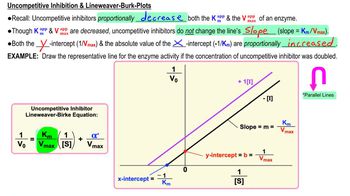
  • Lineweaver-Burk Plot

    Double reciprocal graph of enzyme kinetics; uncompetitive inhibition produces parallel lines as both Km and Vmax decrease.
  • Alpha Prime

    Factor quantifying the degree of inhibition exerted by uncompetitive inhibitors on the enzyme-substrate complex.
  • Catalytic Constant

    Value representing maximum enzyme efficiency; lowered by uncompetitive inhibitors along with Vmax.
  • Turnover Number

    Number of substrate molecules converted per enzyme per unit time; decreases with uncompetitive inhibition.
  • Initial Reaction Velocity

    Rate at which product forms at the start of a reaction; always reduced by enzyme inhibitors, including uncompetitive types.
  • Le Chatelier's Principle

    Concept explaining how decreased enzyme-substrate complex concentration shifts equilibrium to favor more complex formation.
  • Parallel Lines

    Characteristic feature in Lineweaver-Burk plots indicating proportional decreases in Km and Vmax due to uncompetitive inhibition.
  • Double Reciprocal Plot

    Alternative name for Lineweaver-Burk plot, highlighting the use of reciprocals for velocity and substrate concentration axes.