Back

Uncompetitive Inhibition quiz

Control buttons has been changed to "navigation" mode.
1/15
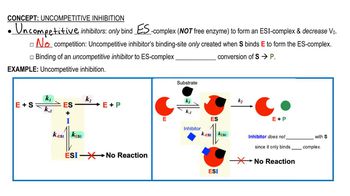
  • What does an uncompetitive inhibitor bind to in an enzyme-catalyzed reaction?

    An uncompetitive inhibitor binds only to the enzyme-substrate complex, not to the free enzyme.
  • Does an uncompetitive inhibitor compete with the substrate for the enzyme's active site?

    No, uncompetitive inhibitors do not compete with the substrate because they only bind after the substrate is already bound to the enzyme.
  • What complex is formed when an uncompetitive inhibitor binds to the enzyme-substrate complex?

    The enzyme-substrate-inhibitor (ESI) complex is formed.
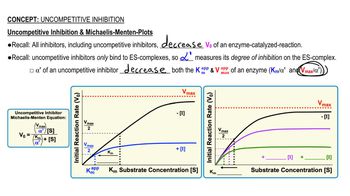
  • How does uncompetitive inhibition affect the apparent Km of an enzyme?

    Uncompetitive inhibition decreases the apparent Km, making it appear as if the enzyme has a higher affinity for the substrate.
  • How does uncompetitive inhibition affect the apparent Vmax of an enzyme?

    Uncompetitive inhibition decreases the apparent Vmax, lowering the maximum reaction rate.
  • Can increasing substrate concentration overcome uncompetitive inhibition?

    No, increasing substrate concentration cannot overcome uncompetitive inhibition because the inhibitor only binds to the enzyme-substrate complex.
  • What happens to both Km and Vmax in the presence of an uncompetitive inhibitor?

    Both Km and Vmax decrease proportionally in the presence of an uncompetitive inhibitor.
  • How does uncompetitive inhibition appear on a Michaelis-Menten plot?

    On a Michaelis-Menten plot, uncompetitive inhibition shifts the curve downward, showing lower Vmax and Km.
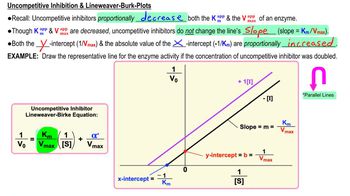
  • What is the effect of uncompetitive inhibition on the Lineweaver-Burk plot?

    Uncompetitive inhibition results in parallel lines on the Lineweaver-Burk plot, with both the y-intercept (1/Vmax) and x-intercept (-1/Km) increasing.
  • Does the slope (Km/Vmax) change in a Lineweaver-Burk plot with uncompetitive inhibition?

    No, the slope (Km/Vmax) remains unchanged because both Km and Vmax decrease proportionally.
  • What mnemonic can help you remember the effects of uncompetitive inhibition?

    The 'U-turn' mnemonic helps remember that both Km and Vmax go down (decrease) in uncompetitive inhibition.
  • Why does uncompetitive inhibition decrease the apparent Km?

    It decreases the apparent Km because binding of the inhibitor to the enzyme-substrate complex shifts the equilibrium to form more ES, making the enzyme appear to have higher substrate affinity.
  • Why does uncompetitive inhibition decrease the apparent Vmax?

    It decreases Vmax because the inhibitor prevents the enzyme-substrate complex from converting substrate to product, even at high substrate concentrations.
  • What happens to the catalytic constant (kcat) in the presence of uncompetitive inhibition?

    The catalytic constant (kcat) decreases along with Vmax because the maximum catalytic efficiency is reduced.
  • How does increasing the concentration of uncompetitive inhibitor affect Km and Vmax?

    Increasing the concentration of uncompetitive inhibitor further decreases both Km and Vmax proportionally.