Back

Waxes definitions

Control buttons has been changed to "navigation" mode.
1/15
  • Fatty Acid

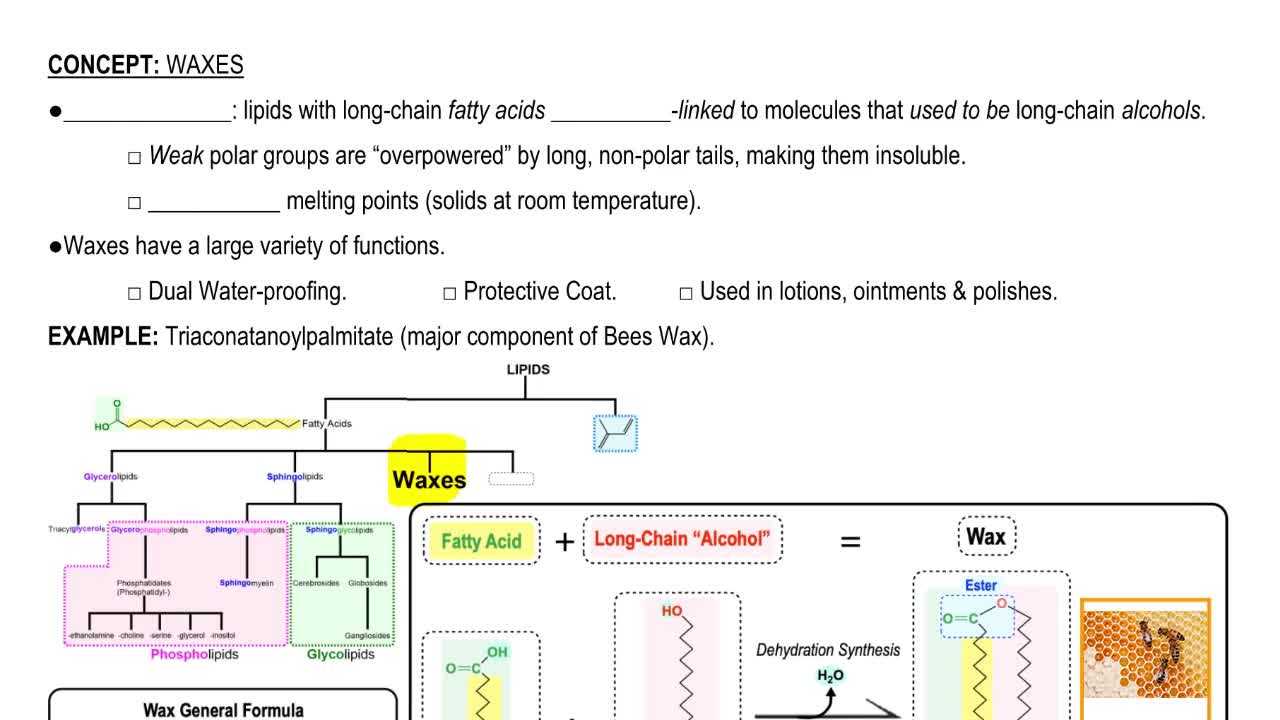
    Long hydrocarbon chain with a carboxyl group, forms the backbone of many lipids including waxes.
  • Long Chain Alcohol

    Hydrocarbon molecule with an alcohol group, reacts with fatty acids to form wax esters.
  • Ester Linkage

    Bond formed between a fatty acid and an alcohol, central to wax structure.
  • Hydrocarbon Chain

    Nonpolar sequence of carbon and hydrogen atoms, imparts hydrophobicity to waxes.
  • Palmitic Acid

    Specific fatty acid often used in wax formation, notably in beeswax.
  • Triacontinol

    Long chain alcohol involved in the synthesis of certain waxes like beeswax.
  • Triacontinoypalmitate

    Major component of beeswax, formed by ester linking palmitic acid and triacontinol.
  • Beeswax

    Natural wax produced by bees, mainly composed of triacontinoypalmitate.
  • Dehydration Synthesis

    Chemical reaction joining fatty acid and alcohol, releasing water and forming wax.
  • Nonpolar

    Characteristic of molecules lacking charge separation, resulting in water insolubility.
  • Hydrophobic

    Property causing repulsion of water, common in waxes due to their hydrocarbon chains.
  • Melting Point

    Temperature at which a solid becomes liquid; waxes typically have high values.
  • Protective Coat

    Layer provided by waxes to shield surfaces from environmental factors.
  • Waterproofing

    Function of waxes preventing water penetration or loss, crucial for plants and products.
  • Lipid

    Class of biomolecules including waxes, characterized by hydrophobicity and energy storage.