What major events occur during anaphase of mitosis?
Verified step by step guidance
1
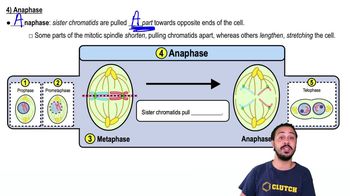
Chromosomes that were previously aligned at the metaphase plate begin to separate. Each chromatid, now an individual chromosome, is pulled toward opposite poles of the cell by the spindle fibers attached to the kinetochore.
The spindle fibers not attached to chromosomes elongate and push apart, further separating the poles and aiding in cell elongation.
The movement of the chromosomes is facilitated by the motor proteins that walk along the microtubules, which depolymerize at their kinetochore ends, effectively pulling the chromosomes along.
As the chromosomes are pulled to opposite poles, the cell begins to elongate, preparing for the final stages of mitosis.
By the end of anaphase, each pole of the cell contains a complete set of chromosomes, ensuring that each daughter cell will have a full set of genetic material after cell division is complete.
Verified video answer for a similar problem:
This video solution was recommended by our tutors as helpful for the problem above
Video duration:
2m
Play a video:
Was this helpful?
Key Concepts
Here are the essential concepts you must grasp in order to answer the question correctly.
Mitosis
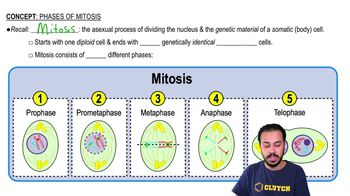
Mitosis is the process of cell division that results in two genetically identical daughter cells from a single parent cell. It consists of several stages: prophase, metaphase, anaphase, and telophase. Each stage plays a crucial role in ensuring that the genetic material is accurately replicated and distributed. Understanding mitosis is essential for grasping how cells reproduce and maintain genetic continuity.
Anaphase is a critical stage of mitosis where the sister chromatids, which are identical copies of chromosomes, are pulled apart toward opposite poles of the cell. This separation is facilitated by the spindle fibers attached to the centromeres of the chromatids. Anaphase ensures that each daughter cell receives an equal and complete set of chromosomes, which is vital for genetic stability.
The spindle apparatus is a structure composed of microtubules that orchestrates the movement of chromosomes during mitosis. It forms during prophase and is responsible for aligning chromosomes at the cell's equatorial plane during metaphase and separating them during anaphase. The proper functioning of the spindle apparatus is crucial for accurate chromosome segregation, preventing errors that could lead to conditions like aneuploidy.