Back
Back Freeman 7th EditionCh. 20 - The Molecular Revolution: Biotechnology, Genomics, and New Frontiers
- What do restriction endonucleases do?
Problem 1
- What do restriction endonucleases do?
Problem 1
Problem 2
What is a plasmid?
a. An organelle found in many bacteria and certain eukaryotes
b. A circular DNA molecule that replicates independently of the main chromosome(s)
c. A type of virus that has a DNA genome and infects certain types of human cells, including lung and respiratory tract tissue
d. A type of virus that has an RNA genome, codes for reverse transcriptase, and inserts a cDNA copy of its genome into cells
Problem 3
After finding a gene that causes a disease, researchers often introduce the defective allele into mice to create an animal model of the disease. Why are these models valuable?
a. They allow the testing of potential drug therapies without endangering human patients.
b. They allow the sequencing of the mutant allele.
c. They allow the production of large quantities of the defective gene product, usually a protein.
d. They allow the study of how the gene was transmitted from parents to offspring.
Problem 4
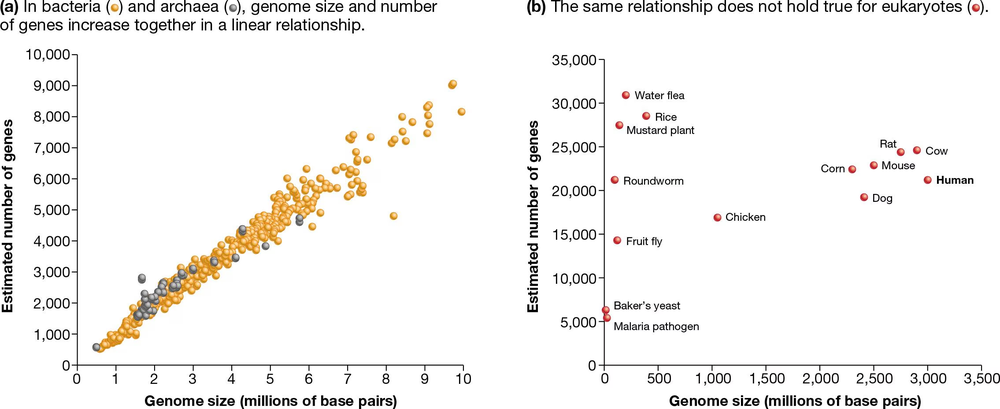
The human genome size is 3 billion base pairs, and the size of the baker's yeast genome, a single-celled organism, is 12 million base pairs. Therefore, the predicted genome size for another single-celled organism, an amoeba,
a. Is about the size of the human genome
b. Is about the size of the yeast genome
c. Is somewhere between the sizes of the yeast and human genomes
d. Cannot be predicted with any certainty
Problem 5
Explain how RNA-seq can be used to analyze patterns of gene expression.
Problem 6
Consider the validity of the following statements about genome editing. Select True or False for each statement.
T/F Cas proteins work as endonucleases.
T/F sgRNA is used by bacterial cells to detect which DNA to cut.
T/F Homologous recombination is always used to join pieces of broken DNA.
T/F It is possible to modify genes as well as disrupt them by genome editing.
Problem 7
Gene density is the number of genes per million base pairs (Mbp). Using Figure 20.5b, find the approximate number of genes estimated in water fleas and in humans, and note the size of each genome. Calculate the gene density in water fleas relative to that in humans.
Problem 8
A friend who works in a research lab performed a GWAS and discovered a tight association between a SNP allele and the disease she is studying. She concluded that the SNP allele must be the mutation that causes the disease. Explain why she is likely to be wrong.
- A friend who works in a research lab performed a GWAS and discovered a tight association between a SNP allele and the disease she is studying. She concluded that the SNP allele must be the mutation that causes the disease. Explain why she is likely to be wrong.
Problem 8
Problem 9
Revolutionaries executed Nicholas II, the last czar of Russia, along with his wife and five children, the family physician, and about a dozen servants. Many decades later, a grave said to hold the remains of the royal family was discovered. Biologists were asked to analyze DNA from the bodies. If the remains of the family were in this grave, predict how similar the DNA fingerprints would be between the parents, the children, and the unrelated individuals in the grave.
- Revolutionaries executed Nicholas II, the last czar of Russia, along with his wife and five children, the family physician, and about a dozen servants. Many decades later, a grave said to hold the remains of the royal family was discovered. Biologists were asked to analyze DNA from the bodies. If the remains of the family were in this grave, predict how similar the DNA fingerprints would be between the parents, the children, and the unrelated individuals in the grave.
Problem 9
Problem 10
One hypothesis for differences between humans and chimpanzees involves differences in gene regulation. A study using RNA-seq showed that the overall patterns of gene expression were similar in the liver and blood of the two species, but the expression patterns were strikingly different in the brain. How do these results relate to the hypothesis?
Problem 11
Potato blight causes potato plants to shrivel and rot. The disease is caused by the pathogen Phytophthora infestans, infamous for its role in Ireland's Great Potato Famine in the mid-1840s. The disease can devastate crops during wet weather, sometimes leading to total crop loss. Researchers aim to use recombinant DNA methods to transfer blight resistance genes from resistant varieties into susceptible varieties of potato. Explain how restriction endonucleases and DNA ligase could be used to insert a potato blight resistance gene into a plasmid.
- Potato blight causes potato plants to shrivel and rot. The disease is caused by the pathogen Phytophthora infestans, infamous for its role in Ireland's Great Potato Famine in the mid-1840s. The disease can devastate crops during wet weather, sometimes leading to total crop loss. Researchers aim to use recombinant DNA methods to transfer blight resistance genes from resistant varieties into susceptible varieties of potato. Explain how restriction endonucleases and DNA ligase could be used to insert a potato blight resistance gene into a plasmid.
Problem 11
- Potato blight causes potato plants to shrivel and rot. The disease is caused by the pathogen Phytophthora infestans, infamous for its role in Ireland's Great Potato Famine in the mid-1840s. The disease can devastate crops during wet weather, sometimes leading to total crop loss. Researchers aim to use recombinant DNA methods to transfer blight resistance genes from resistant varieties into susceptible varieties of potato. Transgenic plants usually contain genes of bacterial plasmid origin. In a recent study, researchers designed a strategy that avoided using any plasmid genes. They transformed cells from a susceptible potato variety with a potato blight resistance gene cloned from a resistant variety. Next, to determine which plants from this group were also free of plasmid DNA (cloning vector) sequences, they performed PCR using primers specific for the plasmid. The positive control lane shows PCR amplification of plasmid DNA only, and the negative control lane shows an attempted PCR amplification of no added DNA. Based on the gel analysis of PCR products shown below, which plants contain only the potato gene? Explain your answer.
Problem 12
Problem 12b
Potato blight causes potato plants to shrivel and rot. The disease is caused by the pathogen Phytophthora infestans, infamous for its role in Ireland's Great Potato Famine in the mid-1840s. The disease can devastate crops during wet weather, sometimes leading to total crop loss. Researchers aim to use recombinant DNA methods to transfer blight resistance genes from resistant varieties into susceptible varieties of potato. Transgenic plants usually contain genes of bacterial plasmid origin. In a recent study, researchers designed a strategy that avoided using any plasmid genes. They transformed cells from a susceptible potato variety with a potato blight resistance gene cloned from a resistant variety. Next, to determine which plants from this group were also free of plasmid DNA (cloning vector) sequences, they performed PCR using primers specific for the plasmid. The positive control lane shows PCR amplification of plasmid DNA only, and the negative control lane shows an attempted PCR amplification of no added DNA. Based on the gel analysis of PCR products shown below, which plants contain only the potato gene? Explain your answer.
Problem 13
If the sequence of DNA in Question 12 were amplified using 25 PCR cycles, then the amount of this DNA would be predicted to increase by -fold.
- If the sequence of DNA in Question 12 were amplified using 25 PCR cycles, then the amount of this DNA would be predicted to increase by -fold.
Problem 13
Problem 14
Why was it important to include a positive control and a negative control in the PCR analysis?
- Why was it important to include a positive control and a negative control in the PCR analysis?
Problem 14
Problem 15
How could the research group determine whether a homologous gene for blight resistance exists in the human genome?
- How could the research group determine whether a homologous gene for blight resistance exists in the human genome?
Problem 15