Pearson+ LogoPearson+ Logo
Ch. 38 - Flowering Plant Reproduction and Development
Freeman - Biological Science 7th Edition
Freeman7th EditionBiological ScienceISBN: 9783584863285Not the one you use?Change textbook
Chapter 38, Problem 8

Human embryonic stem cells are capable of forming all types of cells in the human body. How are these cells similar to meristem cells in plants?

Verified step by step guidance
1
Understand the concept of human embryonic stem cells: These are pluripotent cells, meaning they have the ability to differentiate into any cell type in the human body. They are essential for development and tissue repair.
Learn about meristem cells in plants: Meristem cells are undifferentiated cells found in specific regions of plants, such as the tips of roots and shoots. They are responsible for plant growth and can differentiate into various specialized plant cell types.
Compare the differentiation potential: Both human embryonic stem cells and meristem cells are capable of dividing and differentiating into specialized cells. This ability is crucial for growth and development in both humans and plants.
Examine the role in development: Human embryonic stem cells contribute to the formation of tissues and organs during embryonic development, while meristem cells enable plants to grow new tissues, such as leaves, stems, and roots, throughout their life cycle.
Highlight the shared characteristic of self-renewal: Both types of cells can undergo self-renewal, meaning they can divide to produce more undifferentiated cells, ensuring a continuous supply for growth and repair processes.

Verified video answer for a similar problem:

This video solution was recommended by our tutors as helpful for the problem above.
Video duration:
2m
Was this helpful?

Key Concepts

Here are the essential concepts you must grasp in order to answer the question correctly.

Stem Cells

Stem cells are undifferentiated cells with the unique ability to develop into various cell types. In humans, embryonic stem cells can give rise to all cell types, making them pluripotent. This characteristic is crucial for development and potential therapeutic applications, as they can regenerate damaged tissues.
Recommended video:
Guided course
05:33
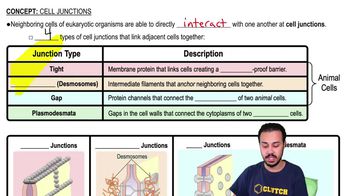
Cell Junctions

Meristem Cells

Meristem cells are the plant equivalent of stem cells, found in specific regions of growth such as the tips of roots and shoots. These cells are also undifferentiated and can divide indefinitely, allowing plants to grow and develop new tissues throughout their life. Meristematic activity is essential for plant growth and regeneration.
Recommended video:
Guided course
07:52
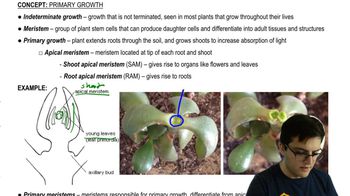
Primary Meristems

Pluripotency vs. Totipotency

Pluripotency refers to the ability of a stem cell to differentiate into nearly all cell types, while totipotency is the capacity to form an entire organism, including extra-embryonic tissues. Human embryonic stem cells are pluripotent, similar to how certain meristem cells can give rise to various plant tissues, highlighting a functional similarity in their roles in growth and development.
Recommended video:
Guided course
03:39
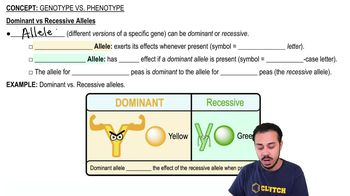
Dominant vs. Recessive Alleles
Related Practice
Textbook Question

Why is the emergence of the radicle an important first step in germination?

a. Its hook helps protect the shoot that emerges later.

b. It carries out photosynthesis to supply the embryo with food.

c. It is important for establishing a supply of water to the growing embryo.

d. It is necessary to break the seed coat.

1073
views
Textbook Question

What are the advantages and disadvantages of self-fertilization versus those of outcrossing?

1225
views
Textbook Question

In what sense are the tissues produced in the shoot and root apical meristems of a 300-year-old oak tree 'embryonic'?

539
views
Textbook Question

Consider the following fruits: an acorn, a cherry, a burr, and a dandelion seed. Based on the structure of each of these fruits, predict how the seed is dispersed.

Design a study that would estimate the average distance that each type of seed is dispersed from the parent plant.

582
views
Textbook Question

Make a sketch of a simplified flower with all four organs, and indicate how the pattern of expression for just two genes (e.g., 'D' and 'E') could, hypothetically, regulate the development of each organ.

Consider that what's important is whether a gene is on or off and that a structure can be specified when neither gene is expressed.

745
views
Textbook Question

Most flowering plants can achieve pollination in several different ways. Those that produce pollen and carpels on the same plant may be self-pollinated, but they may also be cross-pollinated by insects or other pollinators. The cape gooseberry (Physalis peruviana) shown here is able to produce seed whether it is self- or cross-pollinated.

Is one type of pollination better for reproductive success than the other?

Considering the gooseberry flower shown here, what types of cues might attract bees to the plant?

What type of rewards do bees seek?

1206
views