
What is the function of primase? a. Synthesis of the repetitive, short double-stranded DNA sequences required by DNA polymerase. b. Synthesis of a short RNA strand that is complementary to single-stranded DNA. c. Closing the gap at the 3′ end of DNA after excision repair. d. Removing primers and synthesizing a short section of DNA to replace them.
Verified step by step guidance
1
Understand the role of primase in DNA replication. Primase is an enzyme that synthesizes a short RNA primer needed for DNA polymerase to begin DNA synthesis.
Recognize that DNA polymerase cannot initiate the synthesis of a new DNA strand on its own; it requires a primer to provide a starting point.
Identify that the primer synthesized by primase is a short RNA strand that is complementary to the single-stranded DNA template.
Eliminate options that do not describe the synthesis of an RNA primer. For example, options related to DNA synthesis or repair processes are not relevant to the function of primase.
Select the option that correctly describes the synthesis of a short RNA strand complementary to single-stranded DNA, which is the primary function of primase.
Verified video answer for a similar problem:
This video solution was recommended by our tutors as helpful for the problem above
Video duration:
1m
Play a video:
Was this helpful?
Key Concepts
Here are the essential concepts you must grasp in order to answer the question correctly.
Primase Function
Primase is an enzyme that synthesizes a short RNA primer complementary to a single-stranded DNA template. This primer provides a starting point for DNA polymerase to begin DNA synthesis, as DNA polymerases can only add nucleotides to an existing strand. Primase is crucial during DNA replication, particularly on the lagging strand, where it repeatedly lays down primers for Okazaki fragment synthesis.
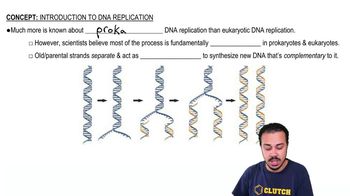
DNA replication is the process by which a cell duplicates its DNA before cell division. It involves unwinding the double helix, synthesizing new complementary strands using the original strands as templates, and ensuring accuracy through proofreading mechanisms. Key enzymes include helicase, primase, DNA polymerase, and ligase, each playing a specific role in the replication process.
An RNA primer is a short segment of RNA synthesized by primase during DNA replication. It is complementary to the DNA template strand and provides a free 3'-OH group for DNA polymerase to extend. The primer is later removed and replaced with DNA nucleotides, ensuring the newly synthesized DNA strand is continuous and complete.