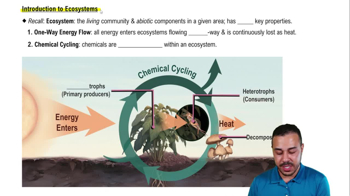
A dynamic system comprising a community of organisms interacting with each other and their physical environment, where energy flows through and matter is recycled.
Biosphere
The global sum of all ecosystems, encompassing all living organisms and their interactions with the atmosphere, hydrosphere, and lithosphere.
Photosynthesis
The process by which autotrophs convert light energy, water, and carbon dioxide into glucose and oxygen, providing energy for themselves and forming the base of the food chain.
Carbon Cycle
The flow of carbon through the biosphere, involving its exchange between the atmosphere, organisms, soil, and oceans, driven by processes like photosynthesis and respiration.
Trophic Levels
The hierarchical positions organisms occupy in a food chain, based on their feeding relationships, from primary producers to apex predators.
Autotrophs
Organisms that produce their own food from inorganic substances using light (photosynthesis) or chemical energy (chemosynthesis), forming the base of the food chain.
Primary Producers
Organisms that convert inorganic materials into organic matter, forming the base of the food chain and supporting all other trophic levels, typically through photosynthesis or chemosynthesis.
Decomposers
Organisms that break down dead organic matter and waste, recycling nutrients back into the ecosystem, ensuring the continuous availability of essential elements for other living organisms.
Detritivores
Organisms that consume non-living organic matter, such as dead organisms and waste, recycling nutrients back into the ecosystem.
Food Web
A complex network of interconnected food chains in an ecosystem, illustrating how energy and nutrients flow through various trophic levels, including producers, consumers, and decomposers.
Gross Primary Productivity
The total energy captured by primary producers from sunlight or inorganic sources in a given area and time, before accounting for energy used in respiration.
Net Primary Productivity
The total amount of new biomass produced by primary producers after subtracting the energy they use for respiration.
Biomagnification
The process where toxins become more concentrated in organisms at higher trophic levels due to the inefficiency of energy transfer in food chains.
 Back
Back
 03:29
03:29