Food webs show the complex feeding relationships and energy flow between producers, consumers, and decomposers in an ecosystem.
What is an animal that eats producers called?
An animal that eats producers is called a herbivore or primary consumer.
What happens to energy as it flows through an ecosystem?
As energy flows through an ecosystem, it is transferred from one trophic level to the next, with some energy lost as heat and waste at each step.
Which animal is a herbivore or primary consumer?
A herbivore or primary consumer is an animal that eats producers, such as plants or algae.
How do decomposers interact with their ecosystem?
Decomposers interact with their ecosystem by breaking down dead organisms and waste, recycling nutrients and maintaining ecosystem health.
What role does a lion play in an ecosystem?
A lion acts as a consumer, specifically a carnivore at a higher trophic level, obtaining energy by eating other animals.
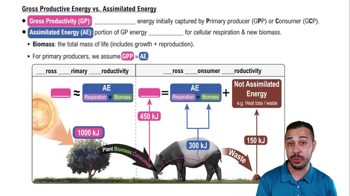
What is the main difference between gross primary productivity (GPP) and gross consumer productivity (GCP)?
GPP refers to the total energy captured by primary producers, while GCP refers to the total energy captured by consumers. GCP is also known as secondary productivity in some textbooks.
How is net productivity (NP) calculated for an organism?
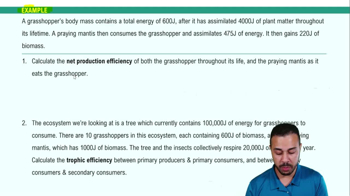
Net productivity is calculated by subtracting respiration energy (R) from assimilated energy (AE). The formula is NP = AE - R.
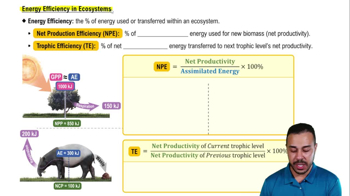
What does net production efficiency (NPE) measure in an ecosystem?
NPE measures the percentage of assimilated energy that is converted into new biomass by an organism. It is calculated as (net productivity / assimilated energy) × 100%.
Why is trophic efficiency (TE) typically low between trophic levels?
Trophic efficiency is low because only a small percentage of net productivity from one trophic level is transferred to the next. On average, TE is around 10% due to energy losses such as heat and waste.
 Back
Back
 05:28
05:28