Skip to main content
General Biology
My Course
Learn
Exam Prep
AI Tutor
Study Guides
Textbook Solutions
Flashcards
Explore
Try the app
My Course
Learn
Exam Prep
AI Tutor
Study Guides
Textbook Solutions
Flashcards
Explore
Try the app
Back
Evolution of Complexity definitions
You can tap to flip the card.
Complex Trait
You can tap to flip the card.
👆
Complex Trait
A characteristic composed of multiple interacting parts, arising through gradual modifications that each provide functional advantages.
Track progress
Control buttons has been changed to "navigation" mode.
1/15
Related flashcards
Related practice
Recommended videos
Evolution of Complexity quiz #1
Evolution of Complexity
1 Term
Evolution of Complexity quiz #2
Evolution of Complexity
9 Terms
Evolution of Complexity
24. History of Life on Earth
4 problems
Topic
Adaptive Radiation
24. History of Life on Earth
5 problems
Topic
24. History of Life on Earth - Part 1 of 2
4 topics
10 problems
Chapter
Jason
24. History of Life on Earth - Part 2 of 2
2 topics
5 problems
Chapter
Guided course
06:15
Origin of Complex Traits
2039
views
20
rank
Terms in this set (15)
Hide definitions
Complex Trait
A characteristic composed of multiple interacting parts, arising through gradual modifications that each provide functional advantages.
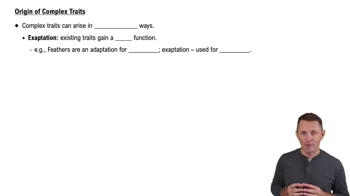
Exaptation
A process where an existing structure acquires a new function, distinct from its original evolutionary role.
Adaptation
A feature shaped by natural selection that enhances survival or reproduction in a specific environment.
Feather
A structure in birds, originally evolved for insulation, later enabling flight through modifications.
Flight Feather
A specialized structure in birds essential for powered flight, derived from earlier forms used for warmth.
Natural Selection
A mechanism where advantageous traits become more common in a population over generations.
Microraptor
A small dinosaur with gliding adaptations, illustrating the evolutionary transition from insulation to flight.
Vertebrate Eye
A complex, camera-like organ in animals with backbones, capable of image formation and focus adjustment.
Eye Spot
A simple light-detecting structure, providing basic information about light presence to early organisms.
Eye Cup
A curved, three-dimensional light-sensitive structure that allows detection of light direction.
Pinhole Eye
A structure with a small opening that forms a basic image by focusing incoming light, similar to a camera obscura.
Lens
A transparent structure in the eye that focuses light to form clear images on sensory cells.
Iris
A muscular ring in the eye that regulates the amount of light entering by adjusting the pupil size.
Mollusk Eye
A camera-like visual organ in mollusks, independently evolved and structurally similar to vertebrate eyes.
Structure-Function Relationship
The principle that the form of a biological feature is closely linked to its role or utility in an organism.
 BackBack
 06:15
06:15