Skip to main content
General Biology
My Course
Learn
Exam Prep
AI Tutor
Study Guides
Textbook Solutions
Flashcards
Explore
Try the app
My Course
Learn
Exam Prep
AI Tutor
Study Guides
Textbook Solutions
Flashcards
Explore
Try the app
Back
Evolution of Protists quiz
You can tap to flip the card.
What is primary endosymbiosis?
You can tap to flip the card.
👆
What is primary endosymbiosis?
Primary endosymbiosis is when a host cell engulfs a prokaryotic cell, leading to a symbiotic relationship.
Track progress
Control buttons has been changed to "navigation" mode.
1/15
Related flashcards
Related practice
Recommended videos
Evolution of Protists definitions
Evolution of Protists
15 Terms
Evolution of Protists
27. Protists
3 problems
Topic
Protist Life Cycles
27. Protists
4 problems
Topic
KeyshawnDavis
27. Protists
4 topics
6 problems
Chapter
Nicole
02:37
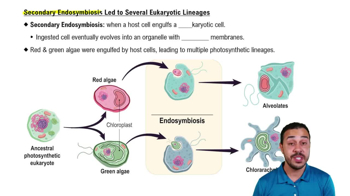
Secondary Endosymbiosis Led to Several Eukaryotic Lineages
2438
views
21
rank
01:43
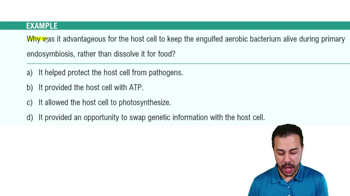
Evolution of Protists Example 1
2187
views
19
rank
01:37
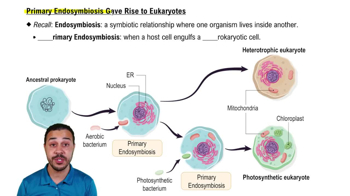
Primary Endosymbiosis Gave Rise to Eukaryotes
2511
views
26
rank
Terms in this set (15)
Hide definitions
What is primary endosymbiosis?
Primary endosymbiosis is when a host cell engulfs a prokaryotic cell, leading to a symbiotic relationship.
What organelle is believed to have evolved from the engulfment of an aerobic bacterium during primary endosymbiosis?
The mitochondrion is believed to have evolved from the engulfment of an aerobic bacterium.
Which organelle evolved from the engulfment of a photosynthetic bacterium in primary endosymbiosis?
The chloroplast evolved from the engulfment of a photosynthetic bacterium.
What is the main difference between primary and secondary endosymbiosis?
Primary endosymbiosis involves engulfing a prokaryotic cell, while secondary endosymbiosis involves engulfing a eukaryotic cell.
What type of cell is engulfed during secondary endosymbiosis?
A eukaryotic cell is engulfed during secondary endosymbiosis.
How many membranes do organelles formed by secondary endosymbiosis typically have?
They typically have three or more membranes, though the exact number can vary.
What is the significance of primary endosymbiosis in the evolution of eukaryotes?
Primary endosymbiosis is believed to have given rise to the first eukaryotes, which were protists.
Which two groups of algae are mentioned as products of primary endosymbiosis?
Red algae and green algae are mentioned as products of primary endosymbiosis.
What happens to the engulfed eukaryotic cell in secondary endosymbiosis over time?
It evolves into an organelle with multiple membranes inside the host cell.
Why is it called 'secondary' endosymbiosis?
It is called 'secondary' because the engulfed eukaryotic cell already contains organelles from primary endosymbiosis.
What is a key indicator that an organelle originated from secondary endosymbiosis?
A key indicator is the presence of three or more membranes around the organelle.
Which two photosynthetic lineages are given as examples of secondary endosymbiosis?
Alveolates and chlorarachniophytes are given as examples.
What is the evolutionary importance of secondary endosymbiosis?
Secondary endosymbiosis led to the diversification of several eukaryotic lineages.
What is the relationship between the host and the engulfed cell in endosymbiosis?
They develop a symbiotic relationship, with the engulfed cell living inside the host.
How does understanding endosymbiosis help us understand the evolution of complex life?
It explains how key organelles originated and how eukaryotic diversity arose, leading to complex life forms.
 BackBack
 02:37
02:37