 Back
BackFreshwater Aquatic Biomes exam

 01:29
01:29
Terms in this set (27)
Oligotrophic Lakes
Nutrient-poor but oxygen-rich lakes with low primary productivity and clear, cold waters.
Eutrophic Lakes
Nutrient-rich but oxygen-poor lakes with abundant plant and algae growth.
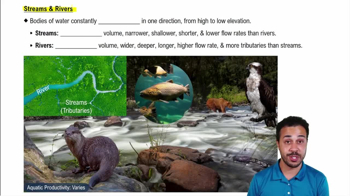
Streams
Smaller flowing bodies of water that contribute to rivers.
Rivers
Larger flowing bodies of water with higher volumes, faster flow rates, and more tributaries.
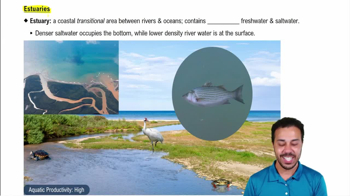
Estuaries
Coastal areas where freshwater from rivers meets saltwater from the ocean, supporting diverse species.
What is the primary difference between oligotrophic and eutrophic lakes?
Oligotrophic lakes are nutrient-poor and oxygen-rich, while eutrophic lakes are nutrient-rich and oxygen-poor.
What type of water bodies are streams and rivers?
Flowing bodies of water, with streams being smaller and rivers being larger.
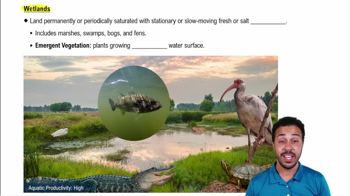
What characterizes wetlands?
Land that is saturated with water, either permanently or periodically, supporting diverse life.
What is an estuary?
A coastal area where freshwater from rivers meets saltwater from the ocean.
What is the Greek root meaning of 'oligo' in oligotrophic?
Few
What does 'trophic' mean in the context of lakes?
Nutrients
What is the Greek root meaning of 'eu' in eutrophic?
Good
What happens to plant and algae growth in eutrophic lakes?
They grow abundantly, leading to oxygen depletion during decomposition.
What is a tributary?
A smaller body of water that flows into a larger one, such as a stream flowing into a river.
What is emergent vegetation?
Plants that grow above the water surface in wetlands.
How does water flow in streams and rivers?
From areas of high elevation to low elevation due to gravity.
What types of water can wetlands contain?
Freshwater or saltwater.
What is the aquatic productivity of estuaries like?
Very high, supporting a wide variety of species.
What happens to saltwater and freshwater in estuaries during high tide?
Saltwater moves upwards into the river, increasing salt concentrations.
What happens to saltwater and freshwater in estuaries during low tide?
Saltwater recedes, and freshwater from the river dominates.
What is the primary productivity of oligotrophic lakes like?
Low, due to the lack of nutrients.
What is the primary productivity of eutrophic lakes like?
High, due to the abundance of nutrients.
What is the primary productivity of wetlands like?
Often quite high, supporting a lot of life.
What is the primary productivity of streams and rivers like?
Varies depending on the specific conditions.
What are the four main types of wetlands?
Marshes, swamps, bogs, and fens.
What is the main characteristic of oligotrophic lakes?
Clear, cold waters with low nutrient levels.
What is the main characteristic of eutrophic lakes?
Abundant plant and algae growth with high nutrient levels.