Skip to main content
General Biology
My Course
Learn
Exam Prep
AI Tutor
Study Guides
Textbook Solutions
Flashcards
Explore
Try the app
My Course
Learn
Exam Prep
AI Tutor
Study Guides
Textbook Solutions
Flashcards
Explore
Try the app
Back
Introduction to Terrestrial Biomes exam
You can tap to flip the card.
Biome
You can tap to flip the card.
👆
Biome
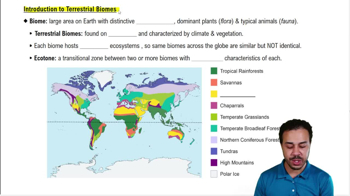
A large area on Earth with distinctive climate, flora, and fauna.
Track progress
Control buttons has been changed to "navigation" mode.
1/29
Related flashcards
Related practice
Recommended videos
Introduction to Terrestrial Biomes quiz #2
Introduction to Terrestrial Biomes
36 Terms
Introduction to Terrestrial Biomes quiz #3
Introduction to Terrestrial Biomes
38 Terms
Introduction to Terrestrial Biomes quiz #4
Introduction to Terrestrial Biomes
40 Terms
Introduction to Terrestrial Biomes
48. Ecology
5 problems
Topic
Terrestrial Biomes: Near Equator
48. Ecology
4 problems
Topic
48. Ecology - Part 1 of 3
4 topics
12 problems
Chapter
Jason
48. Ecology - Part 2 of 3
4 topics
9 problems
Chapter
48. Ecology - Part 3 of 3
2 topics
5 problems
Chapter
01:29
Introduction to Terrestrial Biomes Example 2
1876
views
6
rank
01:55
Introduction to Terrestrial Biomes
2196
views
19
rank
00:49
Introduction to Terrestrial Biomes Example 1
2102
views
11
rank
Terms in this set (29)
Hide definitions
Biome
A large area on Earth with distinctive climate, flora, and fauna.
Terrestrial Biomes
Biomes specifically found on land.
What characterizes terrestrial biomes?
Climate and vegetation.
Echotone
A transitional zone between two or more biomes with mixed characteristics.
Disturbance
A short-lived event that significantly changes or disrupts the structure and function of an ecosystem.
What is a disturbance regime?
Regular or predictable disturbances that a community depends on for long-term survival.
Example of a disturbance
Wildfires.
How do disturbances influence species distribution?
By creating new opportunities for species to disperse and spread.
What is the role of regular wildfires in some biomes?
To prevent fuel accumulation and avoid larger, more destructive fires.
Flora
Dominant plants in a biome.
Fauna
Typical animals in a biome.
What is the significance of understanding biome dynamics?
It is crucial for grasping ecosystem resilience and biodiversity.
How do biomes across different continents compare?
They are similar but not perfectly identical.
What can cause variations in biomes across continents?
Differences in species and local conditions.
What is the impact of a large, destructive fire on a community?
It can completely wipe out the community.
Why are boundaries between biomes not clear-cut?
Because they gradually transition into each other.
What is the role of fuel in wildfires?
Accumulated branches, twigs, and leaves serve as fuel for wildfires.
How do regular small fires benefit a community?
They prevent the accumulation of fuel, reducing the risk of larger fires.
What is the relationship between disturbances and resource availability?
Disturbances can influence resource availability by altering the ecosystem structure.
Why do some biomes depend on disturbances?
To maintain ecological balance and prevent destructive events.
What is an example of a biome that relies on regular wildfires?
Giant sequoia forests in California.
How do disturbances create new opportunities for species?
By disrupting the ecosystem, allowing species to disperse and spread.
What happens without a regular disturbance regime?
Fuel accumulates, leading to larger, more destructive fires.
What is the importance of studying terrestrial biomes?
To understand the unique ecosystems and their dynamics.
How do biomes contribute to biodiversity?
By hosting unique ecosystems with diverse species.
What is the effect of a disturbance on an ecosystem's structure?
It significantly changes or disrupts the structure.
Why are biomes dynamic?
Because of disturbances that alter their structure and function.
What is the role of climate in defining a biome?
Climate is a primary characteristic that defines a biome.
How do biomes transition into each other?
Through echotones, which are gradual transitional zones.
 BackBack
 01:29
01:29