Back

Linear Population Growth definitions

Control buttons has been changed to "navigation" mode.
1/13
  • Linear Population Growth

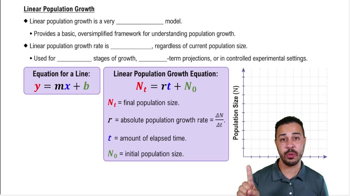
    A model where population increases by a fixed amount each time period, resulting in a straight-line graph.
  • Constant Growth Rate

    A situation where the rate of increase remains unchanged regardless of population size.
  • Population Size

    The total number of individuals present in a population at a specific time.
  • Initial Population Size

    The starting number of individuals before any growth has occurred in a population model.
  • Final Population Size

    The total number of individuals present after a specified period of growth.
  • Absolute Population Growth Rate

    A fixed value representing the change in population per unit time, unaffected by current population.
  • Elapsed Time

    The duration over which population change is measured in a growth model.
  • Short-term Projection

    An estimate of population changes over a brief period, useful for initial growth analysis.
  • Oversimplification

    A model characteristic where complex real-world factors are ignored, making analysis less realistic.
  • Controlled Experimental Setting

    A research environment where variables are regulated, allowing simplified models to be applied.
  • Exponential Growth Model

    A framework where population increases at a rate proportional to its current size, unlike linear models.
  • Logistic Growth Model

    A model incorporating limits to growth, resulting in an S-shaped curve as resources become scarce.
  • Equation for a Line

    A mathematical expression (y = mx + b) used as the basis for the linear population growth formula.