What is gross primary productivity (GPP) in an ecosystem, and how is it determined?
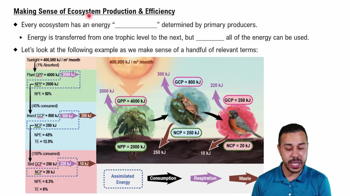
Gross primary productivity (GPP) is the total amount of energy captured by primary producers (autotrophs) from the sun through photosynthesis. It represents the initial energy assimilated before any is lost to cellular respiration or waste. GPP is determined by the fraction of solar energy absorbed by primary producers, which is typically a small percentage of the total energy available from sunlight.
Does algae use all the energy in sunlight to perform photosynthesis? Explain your answer.
No, algae do not use all the energy in sunlight to perform photosynthesis. Only a small fraction of the total solar energy is absorbed and used by algae and other primary producers; most of the energy is either reflected or does not reach photosynthesizing parts. Typically, only about 1% of the sun's energy is captured for photosynthesis.
What does the term 'energy budget' refer to in the context of an ecosystem?
The energy budget is the total amount of energy available in an ecosystem, determined by the energy captured by primary producers. It sets the upper limit for energy flow through all trophic levels.
How is net primary productivity (NPP) calculated from gross primary productivity (GPP) in plants?
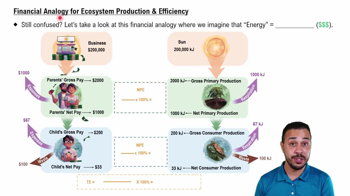
Net primary productivity is calculated by subtracting the energy lost to cellular respiration from the gross primary productivity. NPP represents the energy available for growth and consumption by herbivores.
What happens to the majority of energy as it moves from one trophic level to the next in an ecosystem?
Most of the energy is lost as heat through cellular respiration and as waste at each trophic level. Only a small fraction is transferred to the next level for biomass production.
In the example provided, what percentage of the plant's net primary productivity is consumed by the insect?
The insect consumes 40% of the plant's net primary productivity. This means it obtains 800 kilojoules out of the plant's 2,000 kilojoules NPP.
How is net consumer productivity (NCP) determined for a consumer like an insect or bird?
Net consumer productivity is calculated by subtracting the energy lost to cellular respiration and waste from the gross consumer productivity. NCP is the energy available for the consumer's growth and reproduction.
What does net production efficiency (NPE) measure in an ecosystem, and how is it calculated?
Net production efficiency measures the proportion of assimilated energy that is converted into net productivity. It is calculated by dividing net productivity by assimilated energy and multiplying by 100%.
Why do trophic efficiencies tend to average around 10% across ecosystems?
Trophic efficiencies average around 10% because most energy is lost as heat and waste during transfers between trophic levels. This consistent loss limits the amount of energy available to higher trophic levels.
In the financial analogy, what does the 'net pay' of the parents represent in terms of ecosystem energy flow?
The parents' net pay represents the net primary productivity, which is the energy available for new biomass and for consumption by the next trophic level. It is the leftover energy after expenses (cellular respiration) are subtracted from gross pay (GPP).
 Back
Back
 07:47
07:47