Marine Aquatic Biomes exam Flashcards

Marine Aquatic Biomes exam
Control buttons has been changed to "navigation" mode.
1/28
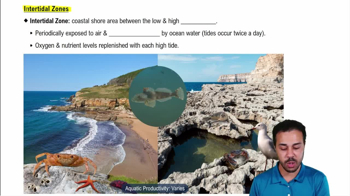
  • Intertidal Zone
    The coastal shore area between high and low tides, experiencing exposure and submersion twice daily.
  • What adaptations do organisms in the intertidal zone have?
    They have evolved to survive fluctuating conditions of exposure to air and submersion by ocean water.
  • Marine Pelagic Zone
    Also known as the open ocean, it covers three-quarters of Earth's surface and includes the entire ocean from the surface to just above the ocean floor.
  • How does sunlight affect the marine pelagic zone?
    Sunlight decreases with depth, leading to varying productivity in different layers of the ocean.
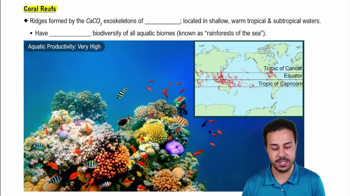
  • Coral Reefs
    Biodiversity hotspots formed by calcium carbonate exoskeletons of coral polyps, found in warm, shallow waters.
  • Why are coral reefs known as the rainforests of the sea?
    Because they have the highest biodiversity of all aquatic biomes.
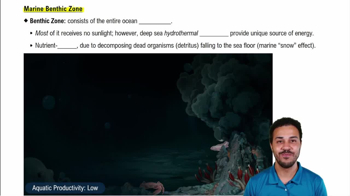
  • Marine Benthic Zone
    The ocean floor, nutrient-rich due to decomposing biomass, supporting unique ecosystems.
  • What is the marine snow effect?
    The process where decomposing dead organisms, or detritus, fall to the sea floor, enriching the benthic zone with nutrients.
  • What are hydrothermal vents?
    Deep-sea features that provide a unique source of chemical energy, supporting specialized organisms in the marine benthic zone.
  • How often do tides occur in the intertidal zone?
    About twice in a period of 24 hours.
  • What is the primary production limitation in the deep marine benthic zone?
    Limited sunlight prevents photosynthesis, restricting primary production.
  • What is the significance of calcium carbonate in coral reefs?
    It forms the sturdy exoskeletons of coral polyps, creating the complex structure of coral reefs.
  • What factors influence productivity in the marine pelagic zone?
    Sunlight and nutrient gradients.
  • What is the role of detritus in the marine benthic zone?
    Decomposing dead organisms enrich the benthic zone with nutrients.
  • What are the conditions required for coral reefs to thrive?
    Warm, shallow waters with specific environmental conditions.
  • What is the oxygen gradient in the marine pelagic zone?
    Oxygen levels decrease with depth.
  • What is the biomass gradient in the marine pelagic zone?
    Biomass decreases with depth.
  • What is the nutrient gradient in the marine pelagic zone?
    Nutrient levels increase with depth.
  • What are tidal pools?
    Pools of water in the intertidal zone that can host specific species of fish and other organisms.
  • How does the intertidal zone replenish oxygen and nutrients?
    High tides submerge the zone, moving water around and redistributing oxygen and nutrients.
  • What is the significance of the marine pelagic zone's size?
    It is the largest biome on Earth, covering about three-quarters of the Earth's surface.
  • What are coral polyps?
    Aquatic animals that secrete calcium carbonate to form coral reefs.
  • What is the primary source of nutrients in the marine benthic zone?
    Decomposing biomass from more productive surface waters.
  • What is the impact of sunlight on the marine benthic zone?
    Most of the benthic zone receives little to no sunlight, limiting photosynthesis.
  • What is the role of hydrothermal vents in the marine benthic zone?
    They provide chemical energy for specialized organisms, supporting unique ecosystems.
  • What is the relationship between depth and nutrient levels in the marine pelagic zone?
    Nutrient levels increase with depth due to sinking decomposing matter.
  • What are the two main types of intertidal zones?
    Sandy beaches and rocky shores.
  • What is the significance of the marine benthic zone's nutrient richness?
    It supports diverse and unique ecosystems, including those near hydrothermal vents.