Which statement best describes how bacteria recycle matter in an ecosystem?
Bacteria recycle matter by breaking down dead organic material, returning essential elements like carbon and nitrogen to the environment.
Bacteria and fungi fulfill which role in an ecosystem?
Bacteria and fungi act as decomposers, breaking down dead organic matter and recycling nutrients back into the ecosystem.
Which type of organism breaks down dead matter and returns carbon and nitrogen into the environment?
Decomposers, such as bacteria and fungi, break down dead matter and return carbon and nitrogen to the environment.
What are two roles prokaryotes play in the cycling of elements in an ecosystem?
Prokaryotes perform nitrogen fixation and act as decomposers in the carbon cycle.
What role do lichens play in the environment?
Lichens contribute to soil formation and nutrient cycling by breaking down rocks and organic material.
What organisms break down the remains of dead organic matter?
Decomposers, including bacteria and fungi, break down the remains of dead organic matter.
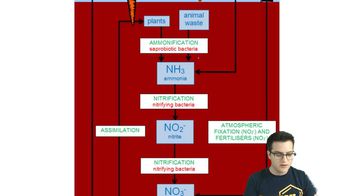
How do prokaryotes contribute to the nitrogen cycle?
Prokaryotes perform nitrogen fixation, converting atmospheric nitrogen into forms usable by plants and other organisms.
What is the role of cyanobacteria in the carbon cycle?
Cyanobacteria contribute to the carbon cycle by performing photosynthesis and producing oxygen.
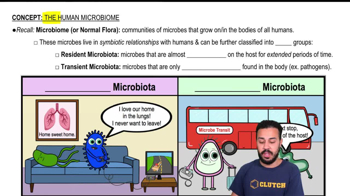
What is the difference between resident and transient microbiota?
Resident microbiota reside in the body long-term, while transient microbiota are temporarily present.
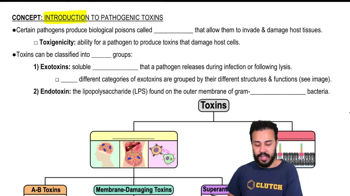
What are exotoxins and endotoxins?
Exotoxins are soluble proteins released by pathogens, while endotoxins are lipopolysaccharides found in the outer membrane of gram-negative bacteria.
Which types of organisms are responsible for breaking down chemical wastes in a treatment plant?
Bacteria and archaea, which are prokaryotes, are responsible for breaking down chemical wastes in treatment plants by acting as decomposers.
What role do prokaryotes play in the breakdown of chemical waste in environmental treatment processes?
Prokaryotes, specifically bacteria and archaea, function as decomposers that break down chemical waste, facilitating nutrient cycling and waste treatment.
Why are bacteria and archaea important in the operation of treatment plants?
Bacteria and archaea are important in treatment plants because they decompose organic matter and chemical wastes, enabling the recycling of nutrients and purification of water.
How do prokaryotes contribute to the cycling of matter in treatment plants?
Prokaryotes contribute to the cycling of matter in treatment plants by breaking down chemical and organic wastes, which helps recycle nutrients such as carbon and nitrogen.
 Back
Back
 05:34
05:34