Skip to main content
General Biology
My Course
Learn
Exam Prep
AI Tutor
Study Guides
Textbook Solutions
Flashcards
Explore
Try the app
My Course
Learn
Exam Prep
AI Tutor
Study Guides
Textbook Solutions
Flashcards
Explore
Try the app
Back
Redox Reactions exam
You can tap to flip the card.
Redox Reactions
You can tap to flip the card.
👆
Redox Reactions
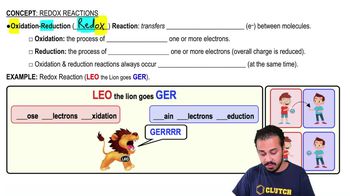
Reactions involving the transfer of electrons between molecules.
Track progress
Control buttons has been changed to "navigation" mode.
1/29
Related flashcards
Related practice
Recommended videos
Redox Reactions definitions
Redox Reactions
8 Terms
Redox Reactions quiz #1
Redox Reactions
17 Terms
Redox Reactions
8. Respiration
3 problems
Topic
Jason
Introduction to Cellular Respiration
8. Respiration
3 problems
Topic
Jason
8. Respiration - Part 1 of 2
6 topics
8 problems
Chapter
Jason
8. Respiration - Part 2 of 2
5 topics
8 problems
Chapter
Brendan
01:44
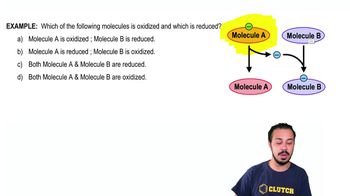
Redox Reactions Example 1
18972
views
314
rank
05:22
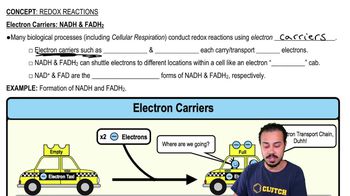
Electron Carriers: NADH & FADH2
23508
views
359
rank
6
comments
04:47
Redox Reactions
26277
views
534
rank
Terms in this set (29)
Hide definitions
Redox Reactions
Reactions involving the transfer of electrons between molecules.
Oxidation
The process of losing one or more electrons.
Reduction
The process of gaining one or more electrons.
What does NADH stand for?
Nicotinamide adenine dinucleotide (reduced form).
What is the role of NADH and FADH2 in cellular respiration?
They act as electron carriers, transporting electrons to the electron transport chain.
NAD+
The oxidized form of NADH, having lost electrons.
FAD
The oxidized form of FADH2, having lost electrons.
What mnemonic helps remember oxidation and reduction?
LEO the lion says GER (Losing Electrons is Oxidation, Gaining Electrons is Reduction).
Electron Transport Chain
The final stage of cellular respiration where electrons are transferred to produce ATP.
What happens during oxidation?
A molecule loses electrons.
What happens during reduction?
A molecule gains electrons.
Electron Carriers
Molecules like NADH and FADH2 that transport electrons during cellular respiration.
Why are NADH and FADH2 called 'electron taxi cabs'?
Because they transport electrons to different locations within a cell.
What is the charge of an electron?
Negative.
What does FADH2 stand for?
Flavin adenine dinucleotide (reduced form).
What is the significance of NAD+ and FAD in redox reactions?
They are the oxidized forms that can accept electrons to become NADH and FADH2.
What is the relationship between oxidation and reduction?
They occur simultaneously; one molecule is oxidized while another is reduced.
What does the 'H' in NADH and FADH2 signify?
The presence of hydrogen, indicating the reduced form of the molecules.
What is the role of electrons in redox reactions?
Electrons are transferred from one molecule to another, driving the reactions.
Why is understanding redox reactions important?
It is crucial for grasping metabolic pathways and energy transfer in biological systems.
What does the term 'oxidized' mean?
A state where a molecule has lost electrons.
What does the term 'reduced' mean?
A state where a molecule has gained electrons.
How do NADH and FADH2 differ in their electron carrying capacity?
Both can carry a maximum of 2 electrons, but FADH2 also carries 2 hydrogen ions.
What is the significance of the electron transport chain?
It is where the energy from electrons is used to produce ATP during cellular respiration.
What is the mnemonic for remembering the process of oxidation and reduction?
LEO the lion says GER.
What happens to NAD+ when it gains electrons?
It becomes NADH.
What happens to FAD when it gains electrons?
It becomes FADH2.
Why do oxidation and reduction always occur together?
Because the electrons lost by one molecule are gained by another.
What is the role of hydrogen ions in the formation of NADH and FADH2?
They are picked up along with electrons to form the reduced versions of these carriers.
 BackBack

 01:44
01:44