Skip to main content
General Biology
My Course
Learn
Exam Prep
AI Tutor
Study Guides
Textbook Solutions
Flashcards
Explore
Try the app
My Course
Learn
Exam Prep
AI Tutor
Study Guides
Textbook Solutions
Flashcards
Explore
Try the app
Back
Cellular Respiration and Energy Production
You can tap to flip the card.
What is the primary molecule that stores energy in cells?
You can tap to flip the card.
👆
What is the primary molecule that stores energy in cells?
The primary molecule is
adenosine triphosphate (ATP)
, which stores energy in its chemical bonds.
Track progress
Control buttons has been changed to "navigation" mode.
1/20
Recommended videos
01:53
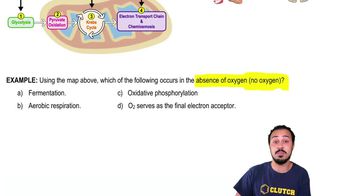
Introduction to Cellular Respiration Example 2
20146
views
234
rank
04:18
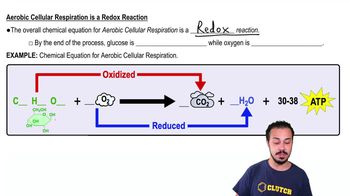
Aerobic Cellular Respiration is a Redox Reaction
31203
views
477
rank
02:31
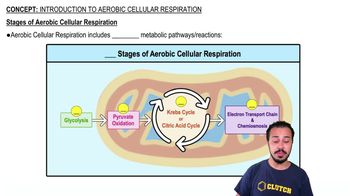
Stages of Aerobic Cellular Respiration
23789
views
362
rank
1
comments
Terms in this set (20)
Hide definitions
What is the primary molecule that stores energy in cells?
The primary molecule is
adenosine triphosphate (ATP)
, which stores energy in its chemical bonds.
What are the two main stages cells use to break down glucose for energy?
Cells break down glucose in two stages:
glycolysis
and
cellular respiration
.
Where does glycolysis occur and what does it produce?
Glycolysis occurs in the
cytoplasm
and produces
2 ATP
and
2 pyruvate molecules
from one glucose molecule.
What happens to pyruvate in the presence of oxygen?
Pyruvate enters the mitochondria and is broken down into
CO2, water, and 34-36 ATP
through cellular respiration.
What is fermentation and when does it occur?
Fermentation is an anaerobic process that occurs when oxygen is absent, converting pyruvate into
lactate or ethanol and CO2
without producing ATP.
What is the overall chemical equation for cellular respiration?
The equation is
C6H12O6 + 6 O2 → 6 CO2 + 6 H2O + ATP + heat
.
What are the four metabolic pathways involved in glucose metabolism?
They are
glycolysis, pyruvate breakdown, Krebs cycle, and oxidative phosphorylation
.
What is the role of NAD+ in glycolysis?
NAD+ accepts electrons and hydrogen ions to form
NADH
, a high-energy electron carrier.
What happens during the activation phase of glycolysis?
Glucose is phosphorylated by two ATP molecules to form
fructose bisphosphate
, making it more reactive.
What is produced during the energy harvest phase of glycolysis?
Two molecules of
G3P
are converted to pyruvate, producing a net gain of
2 ATP
and
2 NADH
.
Where does cellular respiration occur in eukaryotic cells?
It occurs in the
mitochondria
, specifically in the matrix and inner membrane.
What happens to pyruvate in the mitochondrial matrix?
Pyruvate is converted to
acetyl CoA
, releasing CO2 and producing NADH.
What is the Krebs cycle and what does it produce per acetyl CoA?
The Krebs cycle is a metabolic cycle that produces
2 CO2, 1 ATP, 3 NADH, and 1 FADH2
per acetyl CoA.
What is the electron transport chain (ETC)?
The ETC is a series of protein complexes in the mitochondrial inner membrane that transfer electrons and pump protons to create a gradient.
What is the role of oxygen in the ETC?
Oxygen acts as the
final electron acceptor
, combining with electrons and protons to form water.
What is chemiosmosis in cellular respiration?
Chemiosmosis is the process where protons flow back through ATP synthase, driving the synthesis of
ATP
from ADP and phosphate.
How many ATP molecules are produced from one glucose molecule during cellular respiration?
Between
36 and 38 ATP
molecules are produced per glucose molecule.
Why is fermentation necessary in anaerobic conditions?
Fermentation regenerates
NAD+
so glycolysis can continue producing ATP without oxygen.
What are the two main types of fermentation?
They are
lactic acid fermentation
(producing lactate) and
alcoholic fermentation
(producing ethanol and CO2).
How do muscle cells use fermentation during intense activity?
Muscle cells convert pyruvate to
lactate
to regenerate NAD+ when oxygen is scarce.
 BackBack
 01:53